入
Character Story & Explanation
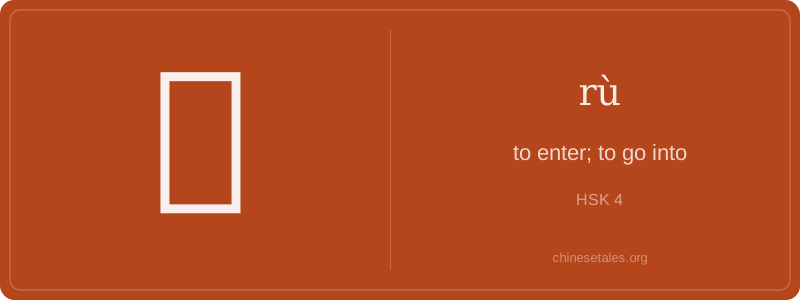
Carved onto oracle bones over 3,000 years ago, the earliest form of 入 looked like two converging lines — a stylized depiction of a foot stepping *over* a threshold or boundary line. Imagine kneeling slightly, one leg bent forward, toes pointing inward — that sharp, descending stroke you see today is the fossilized trace of that forward step. Over centuries, the character simplified: the upper curve flattened, the lower stroke sharpened, and the ‘foot’ became a clean, confident downward slash — all while preserving its core idea: intentional, irreversible crossing.
This visual logic held firm across dynasties. In the *Analects*, Confucius uses 入 in phrases like 入则孝 (‘When entering [the home], be filial’) — linking physical entry with ethical posture. By the Han dynasty, 入 expanded metaphorically: to ‘enter’ a profession (入仕), a state of emotion (入神 — ‘enter trance’), or even heaven (入土 — ‘enter the earth’, i.e., burial). The stroke itself — just two lines, yet unambiguously directional — became a masterclass in Chinese semiotic economy: minimal form, maximal meaning, always oriented inward.
At its heart, 入 isn’t just ‘to enter’ — it’s the quiet, decisive moment of crossing a threshold: into a room, a country, a state of mind, or even a bureaucratic system. Unlike English verbs that often emphasize motion (‘walk in’, ‘step into’), 入 focuses on the *completion* of entry — the instant you’re no longer outside but *in*. That subtle shift from boundary to belonging is deeply embedded in Chinese thinking: identity, status, and belonging are often defined by inclusion — whether joining a school (入学), gaining citizenship (入籍), or even ‘entering’ meditation (入定).
Grammatically, 入 is surprisingly versatile. It functions as a verb (他入伍了 — ‘He enlisted’), but also appears in resultative complements (听入迷 — ‘listened so intently [into fascination]’), and even as a prefix in formal compounds like 入口 (entrance) or 入流 (to join an elite group). Learners often overuse it where context calls for 进 (e.g., *进房间* not *入房间* in casual speech), because 入 feels ‘more correct’ — but it’s actually more formal, literary, or institutional. You’d say 入党 (join the Party) or 入选 (be selected), never *入超市*.
Culturally, 入 reflects a worldview where boundaries matter — and crossing them carries weight. In classical texts, 入 often signals moral or spiritual transition: 入道 (enter the Dao), 入静 (enter stillness). A common mistake? Confusing 入 with similar-looking characters like 人 (rén, ‘person’) or 八 (bā, ‘eight’) — but more insidiously, learners sometimes misread 入 as ‘going *out*’ because of its downward stroke. Remember: that single diagonal stroke isn’t an exit ramp — it’s a foot stepping *across* the line, decisively inward.