切
Character Story & Explanation
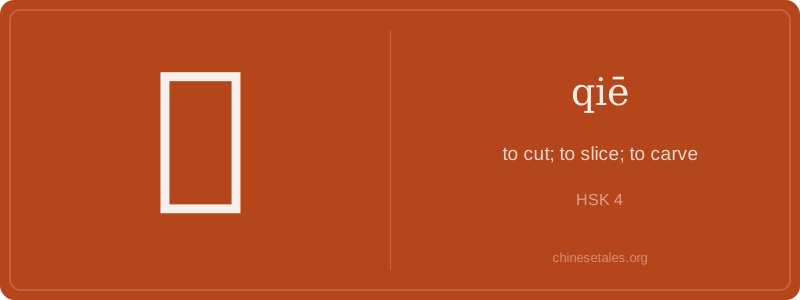
Carved onto oracle bones over 3,000 years ago, the earliest form of 切 looked like a stylized knife (刀) pressing down on a horizontal line — symbolizing the act of severing something cleanly. Over centuries, the line evolved into the shape of 七 (qī), not because of the number seven, but because scribes simplified the original stroke cluster into a more efficient, recognizable form. By the small seal script era (Qin dynasty), the knife radical had firmly settled on the right, while the left component stabilized as 七 — now serving as both structural support and phonetic anchor. Its four strokes were locked in by the Han dynasty: a short diagonal (丿), a horizontal (一), a falling stroke (㇇), then the decisive knife hook (乚).
This character’s meaning stayed remarkably focused: from ancient bronze inscriptions describing ritual animal dissection to Tang poetry praising chefs who could 'cut cloud-like silk' (切云如丝), 切 always implied control, sharpness, and intentionality. In the *Book of Rites*, 切 is used to describe how a proper gentleman ‘cuts through confusion with clarity’ — already extending the physical act into intellectual precision. That duality — blade meeting substance, literal and metaphorical — is baked into every stroke.
At its heart, 切 (qiē) is all about precision and action — not just any cutting, but clean, deliberate slicing: think chef dicing ginger or a surgeon making an incision. The radical 刀 (dāo, 'knife') anchors it visually and semantically in the world of blades and edges, while the top part 七 (qī, 'seven') isn’t numeric here — it’s a phonetic clue hinting at pronunciation (qiē sounds close to qī), and historically helped distinguish this character from others with 刀. This ‘knife + sound’ combo makes 切 feel tactile and intentional — it’s never passive.
Grammatically, 切 shines as a verb (e.g., 切菜 qiē cài, 'to chop vegetables'), but also appears in compound verbs like 切开 (qiē kāi, 'to cut open') and as a separable verb where objects can slot right in: 我切了三片苹果 (Wǒ qiē le sān piàn píngguǒ, 'I sliced three apple pieces'). Learners often overgeneralize and say *切一下* for 'just a little' — fine colloquially — but forget that 切 doesn’t mean 'to cut up' (that’s 切碎 qiē suì) or 'to cut off' (that’s 切断 qiē duàn). Context is everything.
Culturally, 切 carries quiet authority: in classical texts like the *Analects*, 切磋 (qiē cuō, 'to polish/scrutinize together') evokes scholars refining ideas like artisans carving jade — a metaphor still alive today. A common mistake? Confusing 切 with 刻 (kè, 'to engrave') — same knife radical, but 刻 implies permanence and depth, while 切 is surface-level and immediate. Also, don’t miss the second reading: qiè appears in words like 亲切 (qīnqiè, 'intimate') — unrelated to cutting, but a homophone quirk worth noting later.