判
Character Story & Explanation
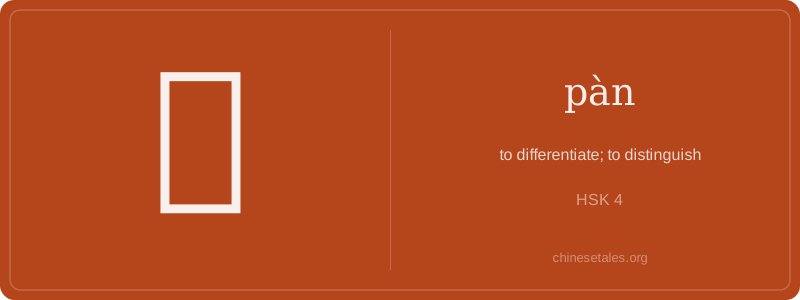
The earliest form of 判 appears in bronze inscriptions as a combination of 半 (bàn, ‘half’) on the left and 刀 (dāo, ‘knife’) on the right — literally ‘cutting in half’. In oracle bone script, 半 itself was drawn as an axe splitting a whole object (like a grain stalk), and adding 刀 reinforced the act of division. Over time, 半 simplified into the top-left component 丷 + 一 + 丨 (a stylized ‘split’), while the knife radical shifted from 刀 to its right-side variant 刂 — standard for characters involving cutting or judgment. By the Han dynasty, the 7-stroke structure we know today was fixed: two strokes for the ‘divided halves’, three for the base, and two for the knife.
This visual logic anchored its meaning: to divide → to differentiate → to adjudicate. In the *Zuo Zhuan*, ministers ‘判其是非’ (pàn qí shìfēi, ‘judge their right and wrong’) — not emotionally, but by applying ritual and precedent like a scalpel. Even today, the shape whispers its origin: look closely — the top resembles two halves pulled apart, and the 刂 at the bottom is the decisive cut that makes the separation official. No wonder it became the go-to character for legal verdicts and scientific classification alike.
At its heart, 判 (pàn) is about cutting through confusion — not with a knife, but with the mind. The radical 刂 (‘knife’) isn’t there for violence; it’s a visual metaphor for precision: to slice apart what’s entangled, to separate truth from illusion, right from wrong. In Classical Chinese, 判 often appeared in legal or philosophical contexts — think of a magistrate drawing a sharp line between guilt and innocence. Today, it retains that decisive, analytical weight: you don’t just ‘see’ differences — you actively *discern*, *judge*, and *assign* categories.
Grammatically, 判 is almost always transitive and requires an object — you 判 something *as* something else, or 判 between two things. It rarely stands alone like ‘decide’ in English. You’ll hear it in phrases like 判定 (pàndìng, ‘to determine conclusively’) or 判别 (pànbié, ‘to distinguish’), where the action implies rigor and authority. Learners often mistakenly use it like 判断 (pànduàn, ‘to judge’) as a standalone verb — but 判 alone feels abrupt, even archaic, unless paired (e.g., in formal writing or compound verbs).
Culturally, 判 carries quiet gravitas: it’s the character used when courts issue rulings (判决, pànjué), when scientists classify species (判别物种), or when AI models output predictions (模型判为阳性). Its tone is sober, not emotional — no room for hesitation. A common slip? Confusing it with 辨 (biàn, ‘to discern’), which emphasizes perception, while 判 emphasizes authoritative conclusion. Think: 辨 = noticing the difference; 判 = signing the verdict.