剩
Character Story & Explanation
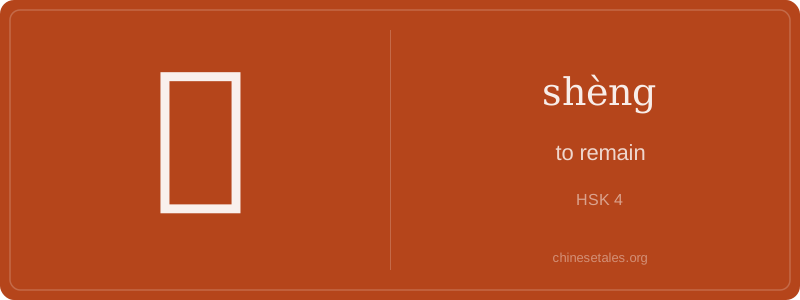
The earliest form of 剩 appears in seal script as a compound: on the left, 乘 (chéng, 'to ride, ascend'), which itself evolved from a pictograph of a person climbing a tree — suggesting upward motion or accumulation; on the right, 刂 (dāo, the knife radical). Over centuries, 乘 simplified into the top-left component (丿 + 冝-like shape), while the knife radical anchored the meaning: imagine cutting away part of something, leaving what *remains behind* — not by accident, but by deliberate subtraction. The modern form crystallized during the Han dynasty, preserving that visceral sense of ‘what survives the cut.’
Classically, 剩 first appeared in Tang dynasty poetry and Song legal texts, always emphasizing residue after depletion — like ‘remaining troops’ after battle or ‘leftover grain’ after tax collection. Its visual duality is poetic: the upper part suggests motion or change (like riding past a point), while the knife radical grounds it in irreversible action. This isn’t passive ‘staying’ — it’s the tangible result of removal. Even today, when you write 剩, your hand traces that ancient logic: first the act of taking, then the stark evidence left behind.
Think of 剩 (shèng) as the quiet survivor in a sentence — it’s not about action, but aftermath. It marks what *endures* after something else has been used up, taken away, or concluded: leftover food, remaining time, unspent money, or even surviving members of a group. Unlike verbs like 留 (liú, 'to leave/keep'), 剩 is inherently relational: it always implies a prior reduction — someone ate some dumplings? Then what’s left is 剩的. That ‘before-and-after’ logic is baked into its grammar.
Grammatically, 剩 shines as both verb and adjective. As a verb, it takes an object and often pairs with 了 (le) or 还 (hái): 饭剩了一半 (fàn shèng le yī bàn) — 'Half the rice remains.' As an adjective, it appears before nouns with 的: 剩下的钱 (shèng xià de qián) — 'the remaining money.' Learners often mistakenly use 剩 without indicating what was removed — e.g., saying *‘剩很多’* alone feels incomplete; native speakers instinctively ask: “Many of *what*, after *what*?” Context or a clear prior event is essential.
Culturally, 剩 carries subtle weight: in China’s post-scarcity era, ‘not wasting’ (不浪费) is deeply tied to respect for labor and resources — so 剩饭 (shèng fàn, 'leftover rice') isn’t just neutral; it can hint at carelessness unless framed positively (e.g., 剩菜打包, 'packing up leftovers'). Also beware: 剩 is never used for abstract 'remaining' in formal administrative contexts — there, you’ll see 余 (yú), like 余额 (yú’é, 'balance'). Confusing them sounds oddly literary… or slightly archaic.