勇
Character Story & Explanation
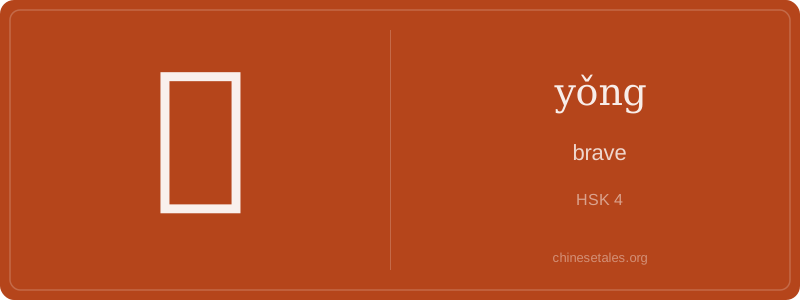
Trace back to oracle bone script (c. 1200 BCE), and 勇 wasn’t a single character — it emerged later from bronze inscriptions as a compound form combining 甬 (yǒng, a phonetic element meaning 'pipe' or 'tunnel', hinting at resonance and flow) atop 力 (lì, 'strength', the radical). Early forms showed 甬’s top strokes (two horizontal lines + a dot or stroke) above the muscular arm-and-club shape of 力. Over centuries, 甬 simplified: its middle vertical line extended downward, merging visually with 力’s right stroke — giving us today’s clean, nine-stroke structure where the upper part looks like 用 minus the bottom horizontal, sitting squarely on 力.
This visual fusion tells a story: courage isn’t abstract — it’s 甬’s resonant, purposeful voice channeled *through* physical strength (力). By the Warring States period, texts like the *Zuo Zhuan* praised '勇而有礼' (yǒng ér yǒu lǐ — 'courageous yet respectful'), cementing its ethical dimension. Mencius ranked courage into three types — the lowest being brute force, the highest being moral courage aligned with heaven’s will. So every time you write those nine strokes, you’re tracing a 2,500-year-old argument about what makes strength virtuous.
At its heart, 勇 (yǒng) isn’t just ‘brave’ like a superhero leaping off a building — it’s the quiet, resolute courage to speak up in class, admit a mistake, or keep practicing tones even when you’re exhausted. In Chinese, it’s almost always an adjective (often paired with 的), but unlike English ‘brave’, it rarely stands alone as a predicate: you’d say 他很勇敢 (tā hěn yǒnggǎn), not *他勇 — that would sound archaic or poetic. Modern usage favors the compound 勇敢 over the single character, especially in speech.
Grammatically, 勇 shines in set phrases and written contexts: 勇于承认错误 (yǒng yú chéngrèn cuòwù — 'courageous in admitting mistakes') is far more natural than *勇承认错误. Learners often mistakenly use 勇 as a verb ('to brave') — but it’s not a verb by itself; you need the preposition 于 or a compound like 勇敢面对. Also, avoid overusing it emotionally: while English might say 'brave decision', Chinese prefers neutral terms like 果断 (guǒduàn, 'decisive') unless moral fortitude is truly central.
Culturally, 勇 carries Confucian weight — it’s one of the 'Five Virtues' (wǔ cháng), but never standalone: true courage must be guided by righteousness (义 yì). That’s why 勇 without 义 can imply recklessness. A common slip? Writing 勇 instead of 永 (yǒng, 'forever') — same pinyin, totally different meaning and radical! Pay attention to that 力 (lì, 'strength') radical — it’s your anchor: courage here is *embodied*, physical, active strength, not just mental resolve.