你
Character Story & Explanation
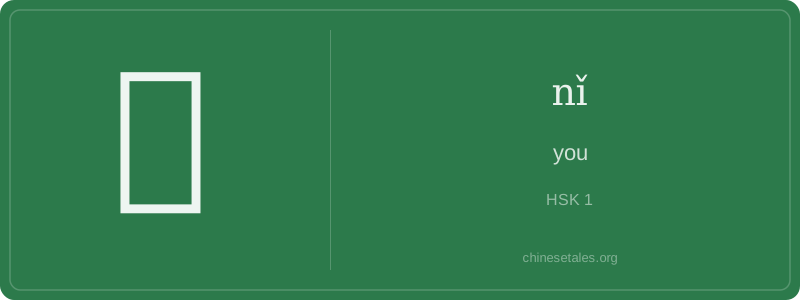
The earliest form of 你 appears in late Warring States bamboo slips, not oracle bones — and it’s a clever fusion. Its left side 亻 (rén bàng, 'person radical') was always the anchor, signaling human involvement. The right side evolved from 尔 (ěr), an ancient pronoun meaning 'you' or 'thus', written with two parallel strokes representing 'a pair' — like two people facing each other. Over centuries, 尔 simplified: its top dots fused into a horizontal stroke, its lower 'x'-shape shrank and tilted, becoming today’s 乚 — a graceful, curling hook that looks like a finger pointing gently outward.
This visual logic held steady: two people implied by the radical + the paired origin of 尔 → 'the person I’m addressing'. In classical texts like the *Analects*, 你 rarely appeared — early Chinese preferred archaic forms like 爾 or 汝. But by the Tang dynasty, 你 surged in vernacular poetry and storytelling, mirroring the rise of spoken language in writing. Its modern simplicity — just seven strokes — reflects a profound shift: from poetic distance to warm, direct address. That little hook? It’s not just a stroke — it’s the curve of a smile offered across space and time.
Think of 你 (nǐ) as Mandarin’s friendly, no-nonsense 'you' — like the universal pronoun that shows up at every party, never late, always ready to point a finger (gently) at whoever you’re talking to. Unlike English, which uses one 'you' for everyone (boss, baby, best friend), Chinese doesn’t change form for number or formality — 你 stays 你 whether you’re whispering to your cat or addressing a room of CEOs. But here’s the twist: it’s *not* neutral in social weight. In formal writing or respectful speech, 你 often gives way to 您 (nín) — a polite upgrade, like switching from 'hey' to 'sir/madam' mid-sentence.
Grammatically, 你 is refreshingly simple: subject position is its sweet spot ('你 好吗?'), but learners stumble when they forget it *never* takes possessive 's' or object-case forms — there’s no 'yours' or 'you' (as object) built into it. Instead, 'your' is always 你的 (nǐ de), and object 'you' is still just 你 — same character, same shape, same tone. No spelling changes, no declensions — just context doing the heavy lifting.
Culturally, 你 carries quiet expectations: using it too soon with elders or superiors can feel jarringly casual — like calling your professor 'dude'. Yet skip it entirely and your sentences collapse ('Like coffee?' → 'Like coffee?' without 你 becomes ambiguous or rude). And beware the silent trap: mispronouncing nǐ as nī (first tone) turns 'you' into 'carve', and nì (fourth tone) means 'to hide' — two very different parties.