味
Character Story & Explanation
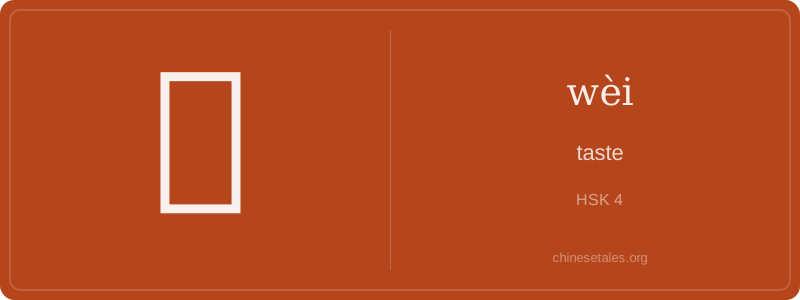
The earliest form of 味 appears in bronze inscriptions around 1000 BCE: a mouth radical (口) on the left, and on the right, a simplified depiction of 未 (wèi), which originally showed tree branches spreading — symbolizing ‘not yet mature’. Together, they evoked the idea of ‘what the mouth discerns before full understanding’: the first impression of flavor, subtle and unfolding. Over centuries, 未 evolved into its modern shape (a horizontal line above two vertical strokes), while 口 stayed steadfast — anchoring the character firmly in the realm of speech and sensation.
This visual logic deepened over time: in the Analects, Confucius praised music that had ‘profound wèi’ (深味 shēn wèi), meaning emotional depth you could almost taste. By the Tang dynasty, poets used 味 to describe the ‘lingering aftertaste’ of a line of verse — proving that long before neuroscientists discovered cross-modal perception, Chinese scribes had already mapped flavor onto feeling, memory, and art. The mouth doesn’t just consume; it contemplates — and that contemplation is written right into the strokes.
At its heart, 味 (wèi) isn’t just 'taste' as in sweet/sour — it’s the *sensory signature* of experience: the tang of nostalgia, the bitterness of regret, even the 'flavor' of a poem or personality. In Chinese, it’s deeply embodied: you don’t just ‘taste’ food — you *feel* its wèi with your whole being. That’s why we say 这道菜味道很好 (zhè dào cài wèi dào hěn hǎo) — literally ‘this dish’s taste-way is very good’, where 味道 (wèi dào) means ‘flavor’ but carries warmth and authenticity.
Grammatically, 味 shines in compound nouns (味觉 wèi jué ‘gustatory sense’, 滋味 zī wèi ‘aftertaste/feeling’) and as a noun in subject/object position — but crucially, it’s *never* used as a verb like ‘to taste’ (that’s 尝 cháng or 品 pǐn). Learners often wrongly say ‘我味这个’ — no! You must say 我尝这个 (wǒ cháng zhè ge). Also, note that 味 alone rarely stands solo; it’s almost always paired — 味道, 口味, 滋味 — like a shy artist who only performs in duets.
Culturally, 味 embodies the Chinese ideal of harmony: a great dish balances five fundamental wèi — sour, bitter, sweet, pungent, salty — reflecting yin-yang balance. And watch out for idioms: 体味 (tǐ wèi) means ‘body odor’, not ‘physical taste’ — a classic slip-up! Also, in literature, 味 can mean ‘aesthetic resonance’ — Du Fu wrote of poetry having ‘lingering wèi’, like tea leaves steeped in silence.