候
Character Story & Explanation
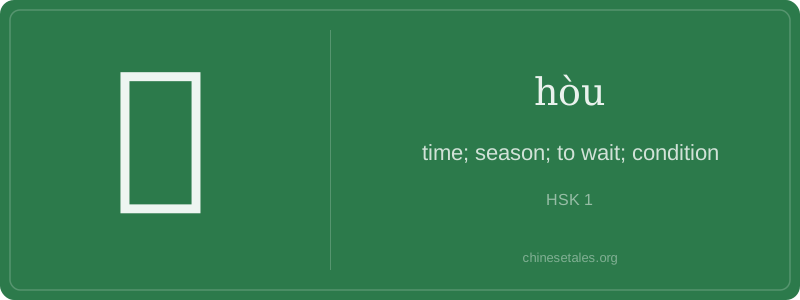
The earliest form of 候 appears in bronze inscriptions as a person (亻) standing before a nobleman (侯, hóu — originally depicting an archer guarding a city gate). The full character was (a variant of 侯) with 人 added — literally ‘a person attending/waiting upon a lord’. Over centuries, the top simplified: 侯’s bow-and-arrow element became 亠+厶, while the person radical 亻 stayed firmly left. By the Han dynasty, it stabilized into today’s 10-stroke structure: 亻 + 侯 — a visual contract between humanity and timing.
This origin explains everything: waiting wasn’t idle — it was duty, vigilance, attunement. In the Book of Rites, officials were called ‘hòu rén’ (waiting persons) who observed celestial signs to announce seasonal shifts. Even today, 候 retains that watchful gravity — not just ‘to wait’, but ‘to be poised for change’. When you see 候 in 时候 (shíhou, ‘time’), you’re not just naming a moment; you’re echoing millennia of people standing still, eyes on the horizon, reading the world’s subtle signals.
Think of 候 (hòu) as the quiet timekeeper of Chinese — not a clock, but the *feeling* of waiting, the rhythm of seasons, or the condition of 'at that moment'. Its radical 亻 (rén bàng, 'person') tells us it’s human-centered: this isn’t abstract time — it’s time experienced *by people*: waiting for a bus, watching for spring, noticing how someone looks *right now*. That ‘waiting’ sense is active and patient, not passive — like standing alert, scanning the horizon.
Grammatically, 候 shines in two key HSK 1 patterns: first, as part of time phrases like 现在 (xiàn zài, 'now') → 现在候? No — wait! Actually, 候 rarely stands alone in modern speech; it’s almost always in compounds (e.g., 等候, 时候). Learners often mistakenly use it like English 'wait' as a verb by itself — but you’d never say *‘wǒ hòu tā’* (I wait him); instead, it’s *děng* or *děng hòu*. Also, in classical-influenced expressions like ‘when…’ clauses, 候 appears in fixed structures like ‘…的时候’, where 的时候 (de shíhou) means ‘at the time when…’ — and here, 候 is silent in pronunciation but essential in writing.
Culturally, 候 carries seasonal weight: ancient China divided the year into 72 ‘pentads’ (wǔ hòu), each marking subtle natural shifts — e.g., ‘cranes fly south’, ‘water begins to freeze’. This reflects how deeply Chinese thought ties human experience to nature’s timing. A common learner trap? Confusing 候 with 后 (hòu, ‘after/back’) — same sound, different meaning and shape. Remember: 候 has 亻 + 侯; 后 has ⼫ + 口. Mixing them turns ‘wait’ into ‘behind’ — a tiny stroke, huge difference.