堵
Character Story & Explanation
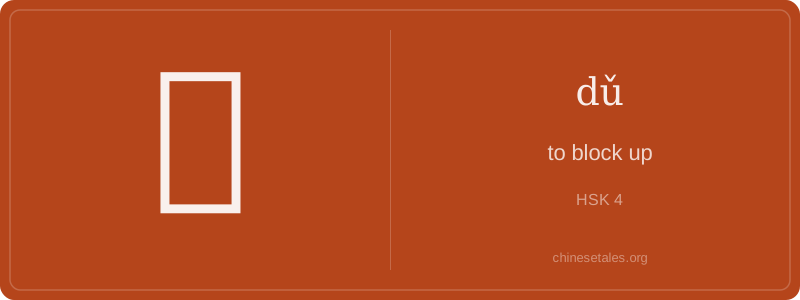
The earliest form of 堵 appears in Warring States bamboo slips as a combination of 土 (earth/soil) and 者 (a phonetic component, pronounced zhě but lending dǔ via sound shift in Old Chinese). Visually, it’s a fortified earthen barrier: the left side 土 anchors it in the material world — soil, clay, rammed earth walls used since Shang dynasty to control floods and defend cities. The right side 者 originally depicted an old man (耂 + 曰), but here it’s purely phonetic, evolving into today’s simplified shape with 11 strokes: two horizontal lines (土), then 者’s curved top, crossbar, and four downward strokes — like fingers pressing down to seal a breach.
This character wasn’t born abstract: in the *Zuo Zhuan*, 堵 describes damming rivers to redirect floods — ‘壅而堵之’ (build up earth and block it). By the Tang, it expanded to human-made obstructions: city gates blocked during sieges, roads sealed by snow. Its visual logic remains intact — earth piled high to halt flow. Even today, when Beijing residents complain about ‘堵车’, they’re echoing engineers who 2,500 years ago raised earthen mounds to hold back the Yellow River.
Picture a wall of earth rising up — not just any wall, but one built to stop water, sand, or even an invading army. That’s the visceral feeling of 堵 (dǔ): it’s not passive obstruction, but *intentional, physical blocking*. The character carries weight and resistance — think traffic jam, clogged drain, or emotional suppression. It’s almost always used as a verb, often in transitive constructions like ‘堵住’ (dǔ zhù, ‘block up’) or ‘堵车’ (dǔ chē, ‘traffic jam’), where the object is concrete and tangible.
Grammatically, learners often misplace it in stative contexts — you wouldn’t say ‘我堵了’ alone to mean ‘I’m blocked’; instead, it needs completion: ‘我的耳朵堵了’ (my ear is clogged) or ‘路被石头堵住了’ (the road was blocked by stones). Notice how 堵 rarely stands alone — it thrives with aspect particles (住, 死, 严) or passive constructions. Also, avoid confusing it with abstract ‘prevention’ (which uses 防止 or 阻止); 堵 is tactile, gritty, and immediate — you can *feel* the pressure behind it.
Culturally, 堵 appears everywhere from urban complaints (‘北京又堵了’ — ‘Beijing’s jammed again’) to classical medicine (ear/nose blockage), and even metaphorically in emotions: ‘心里堵得慌’ (a suffocating, heavy feeling in the chest — not sadness, but *blocked qi*). A common mistake? Using it for ‘to prevent’ in formal writing — that’s 阻止’s job. 堵 belongs on the street, in pipes, and in your sinuses — not in policy documents.