专
Character Story & Explanation
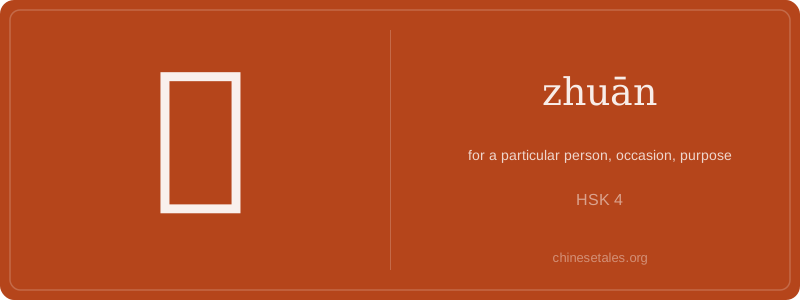
The earliest form of 专, found in Warring States bamboo slips, looks startlingly modern: just four strokes — three short horizontal lines stacked above one long horizontal line. But those aren’t random marks. They evolved from the ancient character 專, which depicted a hand (又) holding thread on a spinning wheel — symbolizing *focused, repetitive action* to twist fibers into strong yarn. Over centuries, the hand and wheel simplified: the ‘thread’ became three short horizontals, and the ‘wheel base’ or ‘platform’ solidified into the bottom stroke — the radical 一 (yī), representing stability and ground. By the Han dynasty, 專 had streamlined into today’s 专, shedding complexity but keeping its core idea: *directed effort anchored in purpose*.
This visual logic shaped its meaning deeply. In classical texts like the *Zuo Zhuan*, 专 described rulers who ‘monopolized authority’ (专权) — not arbitrarily, but with the same single-minded control as a master spinner guiding every twist of the thread. Later, in Tang and Song scholarly discourse, 专 came to signify intellectual dedication — ‘devoting oneself exclusively to one text’ (专一经). Even today, its four-stroke simplicity belies its weight: each short stroke is a thread pulled taut, held firm by the unbroken base — a perfect visual metaphor for concentration that doesn’t waver.
At its heart, 专 (zhuān) isn’t just ‘special’ — it’s about *undivided focus* and *exclusive assignment*. Think of a spotlight narrowing to one person, or a lane reserved for emergency vehicles: it signals singularity of purpose, not mere preference. In Chinese, this character rarely stands alone; it’s the quiet engine behind words like 专业 (zhuānyè, ‘profession’) and 专心 (zhuānxīn, ‘to concentrate’), always implying intentionality and restriction — not just ‘some’ but ‘*only this*, and nothing else’.
Grammatically, 专 often appears as an adverb meaning ‘specifically’ or ‘exclusively’, usually before verbs: 他专教汉语 (tā zhuān jiāo Hànyǔ, ‘He teaches *only* Chinese’). It can also function as a verb meaning ‘to specialize in’, as in 她专攻人工智能 (tā zhuān gōng rénɡōnɡ zhìnéng, ‘She specializes in AI’). Learners often mistakenly use it like English ‘special’ — saying *我很专* — but that’s unnatural; 专 needs context: a target (what you’re focusing on) or a domain (where you specialize).
Culturally, 专 reflects Confucian ideals of mastery through focused cultivation — the scholar who ‘specializes in the classics’ (专精经学) wasn’t dabbling, but committing years to one canon. A common error is confusing it with 专 as a noun (e.g., ‘a specialty’), but in modern Mandarin, 专 almost never functions as a standalone noun — you say 我的专业 (wǒ de zhuānyè), not *我的专. Also, watch tone: zhuān (1st tone) is distinct from zhuǎn (3rd tone, ‘to turn’) — mispronouncing it could make your sentence mean ‘He turns to teach Chinese’ instead of ‘He exclusively teaches Chinese’.