导
Character Story & Explanation
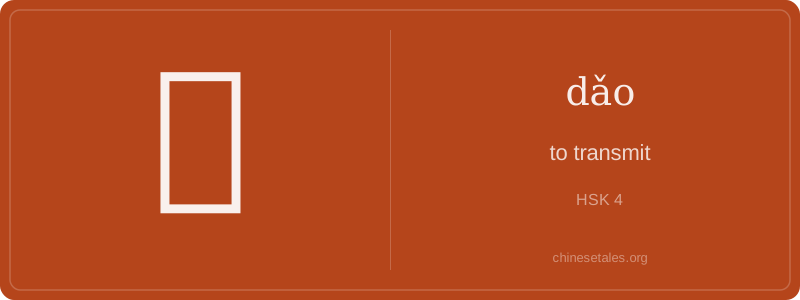
The earliest form of 导, found in late Shang oracle bone inscriptions, was a pictograph showing a hand (又, yòu) reaching toward a path or road (辵/辶 radical in later forms), with a dot or line indicating direction — visualizing deliberate movement *along* a route. Over centuries, the path element evolved into the modern 辶 (chuò) ‘walking’ radical at the bottom, while the top simplified: the ancient hand + path fused into the upper component 1 (a stylized ‘road’ or ‘direction marker’), and the crucial 寸 (cùn, ‘inch’) radical was added at the bottom right during the Han dynasty to emphasize *measured, purposeful action* — not random motion, but calibrated guidance.
This evolution mirrors its semantic journey: from concrete ‘leading someone down a road’ in early texts like the Book of Documents, to abstract ‘causing’ or ‘transmitting’ by the Warring States period. The addition of 寸 — a unit of measurement symbolizing precision and human-scale control — cemented its meaning as *intentional transmission*. By the Tang dynasty, 导 appeared in Buddhist sutras translating Sanskrit ‘pravṛtti’ (‘directing consciousness’), reinforcing its role as a conduit for intangible forces — a nuance still alive today in words like 导电 (dǎo diàn, ‘conduct electricity’).
Think of 导 (dǎo) as the Chinese equivalent of a 'traffic conductor' — not just waving arms, but actively guiding energy, information, or people through a system. Its core meaning isn’t passive ‘to lead’ but dynamic *transmission*: directing signals (like a neural pathway), channeling resources (like a pipeline), or steering attention (like a teacher guiding thought). That’s why it appears in tech terms like 导航 (dǎo háng, 'navigation') — literally 'guiding travel' — and academic ones like 导师 (dǎo shī, 'supervisor'), where the role is less about authority and more about facilitating flow.
Grammatically, 导 is almost never used alone in speech; it’s the engine inside compound verbs and nouns. You won’t say *‘I dǎo you’* — instead, you *引导 (yǐn dǎo)* someone (‘guide + transmit’), *导致 (dǎo zhì)* an outcome (‘transmit + result’ = ‘cause’), or *导入 (dǎo rù)* data (‘transmit + enter’ = ‘import’). A classic learner mistake? Using 导 as a standalone verb like ‘to lead’ — but that’s 领 (lǐng). 导 always implies mediation: something flows *through* or *because of* the action.
Culturally, 导 carries quiet authority — not command, but calibrated influence. In classical texts, it’s linked to Daoist and Confucian ideals of subtle guidance (e.g., Mencius on the ruler who ‘guides the people’s hearts’). Modern learners often overuse it trying to sound formal, but native speakers prefer simpler verbs like 带 (dài, ‘take along’) in casual contexts. Remember: 导 is the behind-the-scenes conductor — essential, invisible, and always in service of the flow.