广
Character Story & Explanation
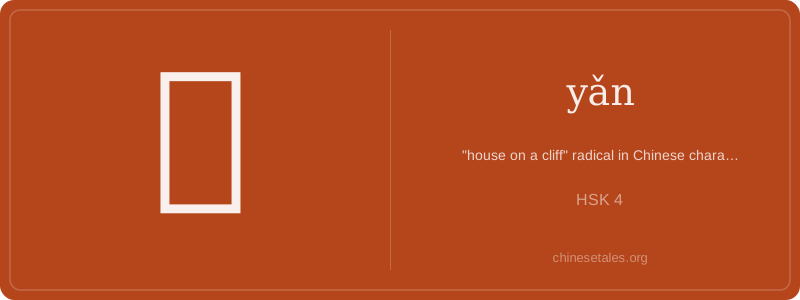
The earliest form of 广 appears in Shang dynasty oracle bone inscriptions as a simple pictograph: a horizontal line (roof) leaning leftward over a vertical stroke (cliff face), with a tiny wedge or dot suggesting an entrance carved into the rock. It wasn’t a free-standing house — it was literally a dwelling *cut into* a mountainside, common in northwestern China’s loess plateaus. Over centuries, the roof line became more angular, the cliff softened into a single downward-sweeping stroke, and the entrance vanished — leaving just three clean strokes: a dot (•), a long left-falling stroke (丿), and a horizontal stroke (一). By the Han dynasty clerical script, it had stabilized into today’s minimalist, elegant form — a cliff-side silhouette in three brushstrokes.
This visual economy shaped its semantic journey: from literal 'cliff-dwelling' to any enclosed, purpose-defined space — first physical (a hall, a store, a bedroom), then abstract (the 'beginning' of a text, the 'foundation' of an argument). In the Shuōwén Jiězì (100 CE), Xu Shen defines it as 'yīn yán ér jiàn wū' — 'a house built facing a cliff' — confirming its architectural roots. Even Confucius’ Analects uses 序 (xù) — with 广 — to mean 'sequence', evoking the ordered layout of ancestral halls. The radical didn’t shrink in meaning; it expanded — becoming the quiet grammar of containment in Chinese writing.
Think of 广 (yǎn) as the architectural 'blueprint stamp' of Chinese characters — not a word you say aloud often, but one that quietly signs off on dozens of dwellings and spaces in writing. Unlike English prefixes like 'pre-' or 'sub-', this radical doesn’t change pronunciation; it’s a silent visual signature meaning 'a sheltered space built against a cliff or slope'. When you see it crowning characters like 店 (diàn, shop), 序 (xù, preface/order), or 底 (dǐ, bottom), you’re looking at ancient real estate: each word implies a defined, bounded, human-made space — whether physical (a shop fronting a hillside) or conceptual (a preface anchoring a text, or the 'bottom' as the foundational layer).
Grammatically, 广 itself is almost never used alone in modern speech — that’s why learners rarely hear yǎn. Its power lies in composition: it signals semantic category, like the '-logy' suffix hinting at 'study of', but visually. Mistake it for 干 (gān, 'dry') or 厂 (chǎng, 'factory'), and you’ll misread entire characters — e.g., confusing 店 (shop) with 旰 (gàn, archaic 'dusk'). And yes, it *also* reads guǎng ('broad') — but that’s a different character (廣 → 广 in simplified form), a homograph trap! The radical 广 (yǎn) and the word 广 (guǎng) are etymologically unrelated twins sharing only a simplified shape.
Culturally, this radical embodies China’s mountainous geography and adaptive architecture — think Fujian tulou or Shaanxi yaodong caves. Learners often overgeneralize, assuming all 'yǎn'-radical words relate to 'cliffs'; instead, focus on the core idea: *a sheltered, defined spatial or structural boundary*. That’s why 库 (kù, warehouse), 床 (chuáng, bed), and even 庆 (qìng, celebration — originally 'ritual space') carry it: they’re all containers — of goods, bodies, or meaning.