底
Character Story & Explanation
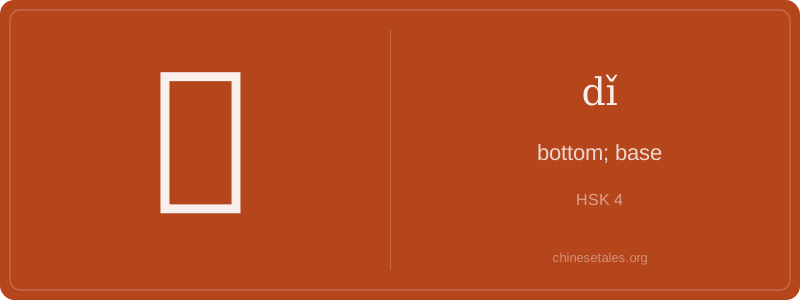
The earliest form of 底 appears in bronze inscriptions as a combination of 广 (a roof-like shelter, later simplified to the 'broad' radical) and 尸 (a crouching person, later evolving into 乇). Together, they depicted someone taking shelter *under* a structure — literally 'beneath the roof'. Over centuries, 尸 morphed into the curved 乇 and then into the modern 丶 + 乚 shape at the bottom right, while 广 retained its open, covering form. By the Han dynasty, the character had stabilized into its current 8-stroke form — a visual promise of shelter, support, and position below.
This 'under-shelter' image gave rise to both concrete and abstract meanings. In the Shuōwén Jiězì (121 CE), Xu Shen defined 底 as 'the lowest part of a thing', anchoring it in spatial hierarchy. But Confucian thinkers soon extended it inward: one’s moral 底 (dǐ) — their inner foundation — became as vital as the base of a pillar. That dual role persists today: whether you're measuring the depth of a well or asking 'what's the real reason?' (到底), 底 remains the quiet, unshakeable point from which everything else rises.
Think of 底 (dǐ) as the Chinese equivalent of the word 'foundation' in architecture — not just the literal bottom layer of a building, but the invisible support that makes everything else possible. In English, we say 'get to the bottom of it' or 'hit rock bottom'; in Chinese, 底 carries that same weight of finality, origin, and grounding — whether you’re talking about the physical floor of a room (地板底), the base of a mountain (山底), or the deepest layer of meaning (道理底). It’s never just decorative: it always signals where things begin, end, or rest.
Grammatically, 底 is rarely used alone — it loves company. You’ll find it glued to nouns (桌底, 'under the table'), forming directional complements (到底, 'after all / on earth'), or as part of abstract compounds like 底线 ('bottom line'). A classic learner trap? Using 底 where you need 低 (dī, 'low') — saying *水底* (shuǐ dǐ, 'water bottom') for 'shallow water' instead of 低水位. Nope! 底 means 'the lowest surface', not 'low in degree'. Also, watch tone: dǐ (third tone) sounds sharp and grounded — like tapping your foot on solid ground.
Culturally, 底 hides quiet authority. In classical texts, 底 often appears in phrases like 有底 (yǒu dǐ, 'has a foundation') — implying reliability, integrity, or moral grounding. Modern slang even uses 到底 (dàodǐ) to demand truth: '到底是谁干的?' ('Who *really* did it?!'). Learners sometimes overuse it thinking it adds emphasis, but native speakers reserve it for moments of culmination or revelation — like pulling back the curtain on reality itself.