厅
Character Story & Explanation
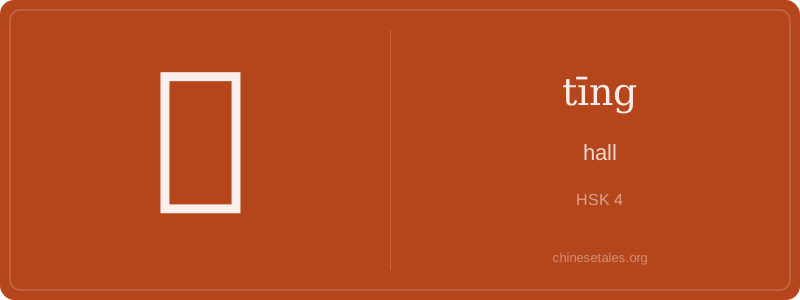
The earliest form of 厅 appears in seal script (c. 3rd century BCE) as a simplified version of 廳 — which itself evolved from a pictograph showing a roof (宀) over a person (丁) standing in an open, sheltered space. Over time, the roof radical 宀 was replaced by 厂 (a cliff-like overhang symbolizing shelter), and the person became the simple stroke 丁 (dīng), originally a nail-shaped glyph representing a standing figure or pillar — now abstracted into two strokes. By the Han dynasty, 厅 emerged as a shorthand for 廳, dropping the 'house' radical to emphasize function over structure: not 'a house with a hall', but 'the hall itself' — a conceptual distillation.
This semantic slimming reflects how Chinese writing values efficiency and context. In classical texts like the *Book of Rites*, '廳' described the main reception area of a noble residence — where guests were formally received, documents signed, and judgments announced. Its visual simplicity (just four strokes!) belies its weight: this tiny character anchors China’s entire bureaucratic nomenclature — from 省政府办公厅 (shěng zhèng fǔ bàn gōng tīng, 'Provincial Government General Office') down to your local community service hall.
Picture a grand, open space under a roof — not a full building, but a dignified, sheltered area where people gather, conduct business, or receive guests. That’s the soul of 厅 (tīng): it’s not just any room, but a formal, semi-public hall — think government office lobby, hotel reception, or a traditional courtyard pavilion. Unlike 房 (fáng, 'room') which implies enclosure and privacy, 厅 evokes openness, function, and social presence. Its radical 厂 (hǎn) — literally 'cliff' or 'overhanging rock' — hints at a roofed-over space, like shelter beneath a rocky ledge.
Grammatically, 厅 is almost always a noun and appears in compound words (never standalone in speech). You’ll rarely say *just* 'tīng' — it’s always 前厅 (qián tīng, 'foyer'), 办公厅 (bàn gōng tīng, 'office hall' → 'department'), or 会议室 (huì yì tīng, 'meeting hall'). Learners often mistakenly use it like English 'hall' in 'dormitory hall' — but Chinese doesn’t say *xuéshēng tīng*; it says 宿舍楼 (sù shè lóu). Also, never confuse it with 厅 as a verb — it has no verbal use whatsoever.
Culturally, 厅 carries quiet authority: government departments (e.g., 教育厅) are named after their physical headquarters halls — a legacy of imperial administrative spaces. A common slip? Writing 厅 instead of 听 (tīng, 'to listen') because of identical pronunciation — but the characters share zero etymology or meaning! Remember: one is stone-and-roof (厂 + 丁), the other is mouth-and hearing (口 + 聽).