愉
Character Story & Explanation
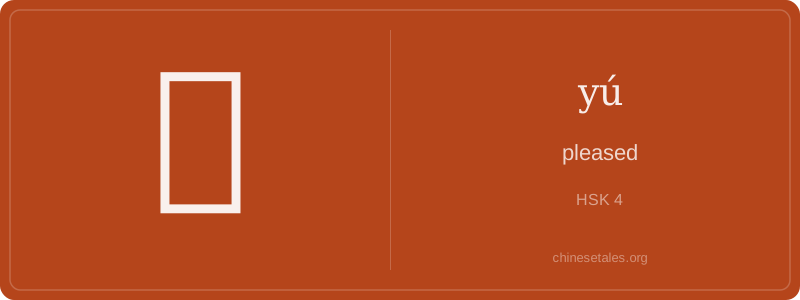
The earliest form of 愉 appears in Warring States bamboo slips—not as a pictograph, but as a phonosemantic compound already. Its left side, 忄 (the 'heart-mind' radical), signals emotional domain; its right side, 俞 (yú), was both sound clue and meaning carrier. 俞 itself evolved from an oracle bone glyph depicting a boat passing smoothly through a narrow channel—a visual metaphor for 'ease, passage without resistance.' Over centuries, the boat shape simplified into today’s 俞: a 'mouth' (口) atop 'boat' (舟) plus 'person' (人), symbolizing effortless transit—and by extension, mental smoothness.
By the Han dynasty, 愉 had crystallized as the go-to character for 'inner ease arising from harmony'—not forced cheer, but the quiet relief of tension dissolving. In the *Analects*, Confucius praises music that makes the heart 'leap and settle' (樂而不淫,哀而不傷), and 愉 captures that settled part: the afterglow of balance. Its strokes—12 precise, flowing lines—mirror this idea: no sharp angles, no rushed endings; even its final stroke curves gently upward, like a sigh releasing into calm.
Think of 愉 (yú) as the Chinese equivalent of a warm, spontaneous smile—not the stiff 'pleased to meet you' handshake, but the genuine, shoulder-relaxing delight you feel when your favorite song comes on unexpectedly. It’s not just 'happy' (that’s 快乐 kuàilè) or 'joyful' (喜悦 xǐyuè); 愉 carries a quiet, inner lightness—like contentment with what *is*, not what *could be*. You’ll rarely hear it alone in speech; it almost always appears in compounds like 愉快 (yúkuài) or 愉悦 (yúyuè), where it softens and deepens the emotion.
Grammatically, 愉 never stands solo as a predicate adjective ('He is pleased')—unlike English, you wouldn’t say *Tā hěn yú*; instead, you’d say *Tā hěn yúkuài* or use it in fixed phrases like *yúkuài de jīnglì* (a pleasant experience). Learners often overuse it trying to translate 'pleased' directly from formal English letters ('I am pleased to inform you…'), but native speakers reach for 高兴 (gāoxìng) or 很荣幸 (hěn róngxìng) there—using 愉 alone sounds oddly literary or even archaic.
Culturally, 愉 evokes Confucian ideals of harmonious ease: not wild euphoria, but the serene satisfaction of balanced relationships and gentle fulfillment. That’s why it appears in classical texts like the *Book of Rites* (Lǐjì), praising rulers whose virtue brought 'people’s hearts at ease' (民心愉). A common trap? Writing it as 榆 (yú, 'elm tree') by mistake—the radical difference (木 vs. 忄) changes everything from emotion to arboriculture!