虑
Character Story & Explanation
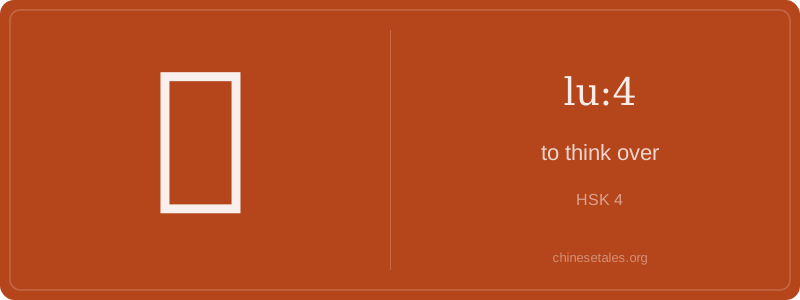
The earliest form of 虑 appears in bronze inscriptions as a complex glyph combining 虍 (hū, tiger head — symbolizing vigilance or danger) above 田 (tián, field — representing structured space or territory) and 心 (xīn, heart/mind) below. Over centuries, the tiger head simplified into the top component we see today (虍 → 丿 + + 一 + 丨), while 田 gradually morphed into the middle 'eye-like' shape (the two horizontal strokes with verticals), and 心 remained firmly anchored at the bottom — visually embodying 'a vigilant mind surveying a field of possibilities'. By the Han dynasty, the structure stabilized into its current 10-stroke form: a vigilant upper element overseeing careful mental terrain.
This evolution mirrors its semantic journey: from early meanings like 'to be apprehensive about danger in one’s domain' (hence the tiger + field) to the broader classical sense of 'to weigh carefully, to anticipate outcomes'. In the *Zuo Zhuan*, ministers are praised for '深谋远虑' (shēn móu yuǎn lǜ) — 'deep strategy and far-sighted consideration' — highlighting how 虑 came to signify strategic foresight, not just worry. The character’s visual hierarchy — vigilant top, structured middle, grounded heart — still whispers that true consideration requires both alertness and calm depth.
Think of 虑 (lǜ) as the Chinese equivalent of 'chewing on a thought' — not just quick thinking, but slow, deliberate mental digestion, like a monk turning over a koan or a lawyer reviewing evidence before closing arguments. It carries weight, care, and caution: you don’t '虑' your lunch order; you 虑 the consequences of quitting your job. That’s why it almost never stands alone as a verb in modern speech — you won’t hear '我虑了' ('I considered') without context. Instead, it lives inside compound verbs (e.g., 考虑, 忧虑) or formal nouns (e.g., 顾虑), much like how English uses 'contemplation' instead of 'contemplate' in solemn contexts.
Grammatically, 虑 is nearly always bound — it’s the quiet engine inside bigger words. You’ll say '我在考虑换工作' (wǒ zài kǎolǜ huàn gōngzuò), not '我在虑换工作'. And watch out: learners often misplace tones — it’s lǜ (fourth tone, falling sharply), *not* lú or lǔ. Also, while 心 (heart/mind) is its radical, this isn’t emotional 'feeling' — it’s cognitive labor rooted in the heart-mind unity of classical Chinese philosophy.
Culturally, 虑 reflects Confucian reverence for thoughtful restraint: haste is suspect, reflection is virtuous. In classical texts like the *Analects*, '君子有九思' ('The gentleman has nine things to consider') includes '视思明,听思聪,色思温…' — each '思' implies deep 虑. A common mistake? Using 虑 where 思 (sī, 'to think') would sound more natural in casual speech — e.g., saying '我虑了一下' instead of '我想了一下' sounds oddly stiff or literary, like saying 'I did some cogitation' at a coffee shop.