拒
Character Story & Explanation
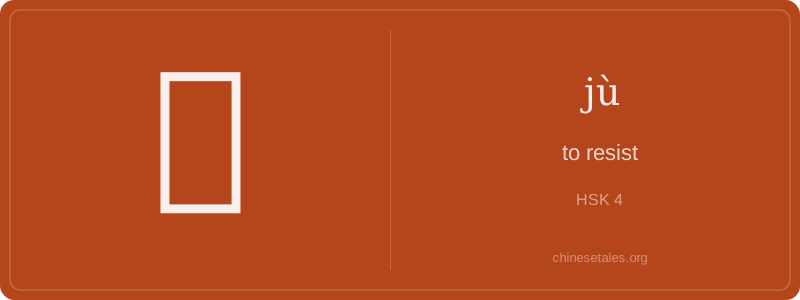
The earliest form of 拒 appears in Warring States bamboo slips as a hand (扌) gripping a bent wooden staff or barrier — imagine a guard thrusting out a pole to block entry. The right side, 巨 (jù), wasn’t originally about size; in oracle bone script, it depicted a person holding a measuring rod upright — symbolizing control, authority, and deliberate measurement. Over centuries, the hand radical stabilized on the left, while 巨 simplified from a figure + rod into its current square-and-cross shape — now evoking ‘rigid structure’ and ‘unyielding stance’.
By the Han dynasty, 拒 had crystallized as ‘to bar by force’ — used in military manuals like the *Weiliaozi* to describe holding fortified gates against siege. In Tang poetry, it gained moral weight: Du Fu wrote of scholars who ‘拒势不屈’ (resist power without yielding), linking physical blocking to ethical fortitude. The character’s visual logic remains striking: 扌 (hand action) + 巨 (imposing, measured resistance) = a gesture so deliberate, it becomes principle.
Think of 拒 (jù) as the Chinese equivalent of slamming a door in someone’s face — not rudely, but firmly, with intention. It’s not passive refusal like ‘I don’t want to’; it’s active resistance: pushing back against pressure, authority, or an unwanted advance. In English, we might say ‘to rebuff’, ‘to spurn’, or ‘to hold at bay’. Unlike the softer 拒绝 (jùjué), which means ‘to refuse’ and often appears in polite contexts (e.g., declining an invitation), 拒 alone carries sharper, more decisive energy — especially in formal or literary usage.
Grammatically, 拒 is almost always transitive and appears in compound verbs or set phrases — you rarely see it solo in modern speech. It pairs tightly with objects: 拒绝 (refuse), 拒斥 (reject with disdain), 拒敌 (repel the enemy). Learners often mistakenly use it like English ‘refuse’ — e.g., *‘Wǒ jù tā de yāoqǐng’ — but that’s ungrammatical; you must say ‘Wǒ jùjué tā de yāoqǐng’. Also, 拒 never takes aspect particles (了, 过) directly — it’s the compound (like 拒绝) that does.
Culturally, 拒 embodies Confucian boundaries: protecting moral integrity by resisting corruption (‘拒腐’), temptation (‘拒色’), or unjust demands. It appears frequently in anti-corruption slogans and classical military texts — where repelling invaders isn’t just physical, but ethical. A common mistake? Using 拒 where 婉拒 (graceful refusal) or 谢绝 (polite decline) would be more appropriate — turning diplomacy into defiance.