冷
Character Story & Explanation
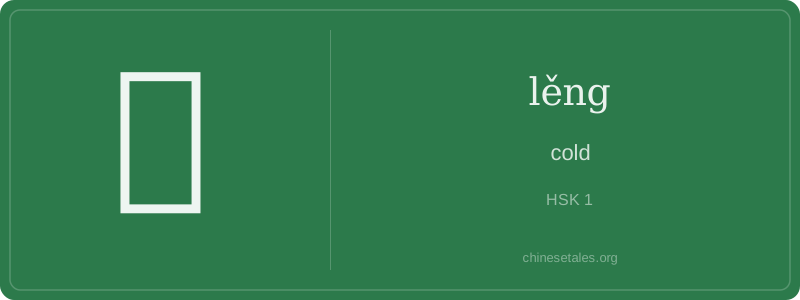
The earliest form of 冷 appears in bronze inscriptions as two ice crystals (冫) beside a person (人) — not the modern 令, but a simplified standing figure. Over time, the person morphed into 令 (a phonetic component meaning ‘command’), while the two dots remained as the radical 冫, representing ice. By the Han dynasty, the character stabilized into its current shape: two icy dots on the left (冫), and 令 on the right — seven strokes total, with the final stroke of 令 sweeping down like a frost-laden branch.
This visual logic held: ice + command = ‘cold’ as a forceful, undeniable condition — not just physical chill, but something that halts motion, silences voices, or commands stillness. In the Book of Songs, 冷 appears in lines about ‘cold winds that still the grass’, linking temperature to emotional restraint. Later, in Tang poetry, poets used 冷 to sharpen imagery — a ‘cold moon’ wasn’t merely low-temperature; it was distant, luminous, and emotionally unyielding — a perfect mirror for the character’s dual nature: simple in form, resonant in feeling.
Think of 冷 (lěng) as the Chinese equivalent of the word 'chill' in English — not just temperature, but also attitude, mood, and even social energy. It’s crisp, sharp, and carries a slight emotional distance: you wouldn’t say 冷 to describe a cozy winter sweater, but you *would* use it for an icy stare or a lukewarm response to bad news. Unlike English ‘cold’, which can be neutral (‘cold water’), 冷 often implies discomfort or abruptness — especially when describing people (e.g., 他很冷 means ‘he’s emotionally detached’, not just ‘he feels cold’).
Grammatically, 冷 is an adjective that usually comes before the noun (冷茶 lěng chá — ‘cold tea’) or after 是 (shì) in descriptions (这杯水是冷的 zhè bēi shuǐ shì lěng de — ‘this cup of water is cold’). Learners often mistakenly drop 的 in spoken contexts, but omitting it makes sentences sound clipped or even childish. Also, note: 冷 never functions as a verb on its own — you don’t ‘cold’ something; you use 冷了 (lěng le) for ‘has gotten cold’ or 凉快 (liángkuai) for ‘cool and refreshing’.
Culturally, 冷 has subtle weight beyond thermometers: in classical poetry, it evokes solitude and quietude (think frost-covered plum branches); in modern slang, 冷场 (lěng chǎng) — ‘cold scene’ — describes an awkward silence that kills a conversation. A common mistake? Confusing 冷 with 凉 (liáng), which is milder, more pleasant, and often used for weather or food — mixing them up is like calling your friend’s breezy balcony ‘arctic’ instead of ‘refreshing’.