拜
Character Story & Explanation
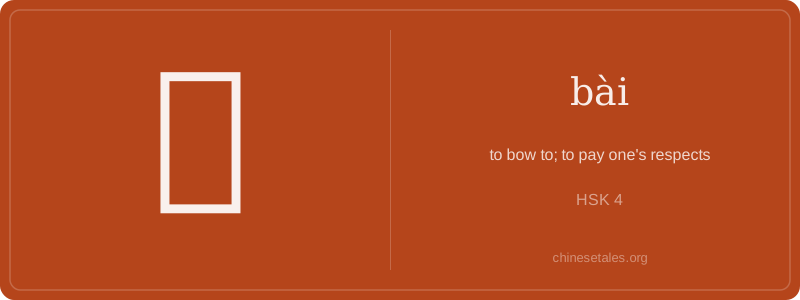
The earliest form of 拜 appears in bronze inscriptions around 1000 BCE: a kneeling figure () with two hands raised symmetrically — one above the other — clearly depicting ritual prostration. Over centuries, the kneeling element simplified into the left-side radical 扌 (a variant of 手, ‘hand’), while the right side evolved from 又 (‘again’, implying repetition) and (kneeling) into the modern 白. By the Han dynasty, the structure stabilized as 扌 + 白 — visually encoding ‘hands performing a repeated, deliberate action’: the very essence of ritual bowing.
This character’s semantic journey mirrors China’s ritual history. In the *Book of Rites*, 拜 refers specifically to the five grades of ceremonial bows — each differing in posture, duration, and social consequence. Confucius emphasized that ‘a proper 拜 must begin in the heart, then move the body’ — making it an ethical act, not just physical. Interestingly, the right-side 白 (bái) isn’t phonetic here; it was likely chosen for its clean, upright shape — symbolizing purity of intent. So every time you write 拜, you’re tracing 3,000 years of embodied philosophy: hands + intention = reverence.
Imagine you’re at a traditional Chinese wedding: the bride and groom kneel together, hands clasped, foreheads touching the floor — not once, but three times — before their elders. That deep, reverent bow? That’s 拜 (bài). It’s not just ‘bowing’ like a quick nod; it’s an embodied act of humility, respect, or solemn commitment — physically lowering yourself to honor someone or something greater. In Chinese, 拜 always implies intentionality and hierarchy: you 拜 your ancestors, 拜 a master teacher, or 拜 the gods — never just ‘bow to the weather.’
Grammatically, 拜 is almost always transitive and followed by a noun or proper name (e.g., 拜老师, 拜佛), and it frequently appears in compound verbs like 拜访 (to visit formally) or 拜托 (to entrust humbly). A common learner mistake is using 拜 alone as an intransitive verb — you wouldn’t say ‘I bowed’ without specifying *whom* or *what* — unlike English ‘bow,’ which can stand alone. Also, note: 拜 is never used for casual greetings (that’s 问好 or 打招呼); it’s reserved for weighty, ritualized moments.
Culturally, 拜 carries Confucian gravity — every bow reinforces relational roles (junior to senior, student to teacher, human to heaven). Even in modern slang, 拜拜 (bàibài) mimics the sound of ‘bye-bye’ but borrows the character’s visual rhythm of repeated reverence — turning farewell into a playful echo of respect. Don’t confuse it with mere politeness: 拜 is devotion made physical.