挺
Character Story & Explanation
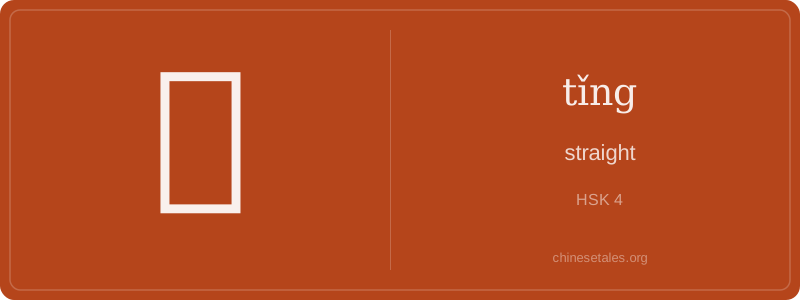
The earliest form of 挺 appears in Warring States bamboo texts, not oracle bones — and it’s a marvel of semantic economy. It combines 扌 (hand radical) on the left with 廷 (a phonetic component meaning 'court', pronounced tíng) on the right. But here’s the twist: 廷 itself originally depicted a palace courtyard with a path running straight through it — a visual metaphor for openness and directness. So 挺 wasn’t just 'hand + court'; it was 'hand acting with the clarity and linearity of a royal thoroughfare' — suggesting deliberate, unswerving action.
This visual logic anchored its meaning: to extend firmly, to stand erect, to uphold. In the *Zuo Zhuan*, 挺 appears in military contexts describing troops 'standing straight' in formation; by the Tang dynasty, poets used it for trees 'standing tall' (tǐng lì) against wind. The shift to adverbial 'quite' emerged in Ming-Qing vernacular fiction, where characters said things like 'tǐng hǎo de' — literally 'standing-out good', i.e., 'noticeably good' — which gradually contracted into everyday emphasis. Even today, when you say 挺棒, you’re echoing ancient imagery of something so upright and prominent, it catches the eye.
At its heart, 挺 is about *resistance to bending* — not just physically straight like a ruler, but morally upright, emotionally steady, or even stubbornly firm. Its radical 扌 (hand) hints that this 'straightness' isn’t passive; it’s an active, embodied stance — you *hold yourself* upright, push back against pressure, or prop something up. That’s why it appears in both concrete verbs ('to prop up', 'to stick out') and abstract adverbs ('quite', 'rather') — the latter evolved from the idea of something standing out prominently, then softened into degree intensification.
Grammatically, it’s delightfully flexible: as a verb (tǐng), it means 'to prop up' or 'to stick out' (e.g., 挺胸 'tǐng xiōng' — 'to puff out one’s chest'); as an adverb (tǐng), it’s colloquial for 'quite' or 'fairly' (e.g., 挺好 'tǐng hǎo' — 'pretty good'). Learners often overuse it like English 'very', but it’s informal and never used before adjectives in formal writing or with negative constructions (you’d never say *挺不好*). Also, it’s never written as a standalone verb without an object — you don’t '挺' alone; you 挺腰, 挺胸, 挺住.
Culturally, 挺 carries quiet strength — think of soldiers standing at attention (tǐng lì), or someone 'holding on' (tǐng zhù) during hardship. Its adverbial use reflects Chinese pragmatism: 'tǐng hǎo' isn’t effusive praise — it’s warm, understated approval, like a nod instead of a cheer. A classic mistake? Confusing it with 廷 (court) or 庭 (courtyard) — same sound, totally different radicals and meanings. Remember: 扌 means hands are involved — you’re *doing* the straightening.