推
Character Story & Explanation
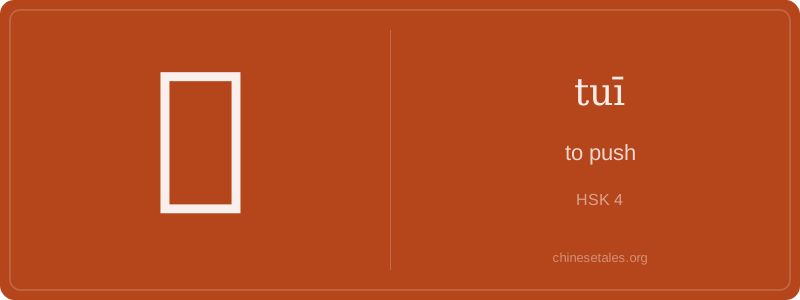
The earliest form of 推 appears in bronze inscriptions around 1000 BCE: a hand (, ancestor of 扌) pressing against a stylized ‘mouth’ (口) with a downward stroke—suggesting a hand applying pressure *onto* or *against* a surface or opening. Over centuries, the hand radical standardized into 扌 on the left, while the right side evolved from 口 + 丿 (a sweeping stroke indicating direction) + 一 (a stabilizing base), crystallizing by the Han dynasty into today’s shape. Notice how the three strokes on the right—丿, 一, and 丶—form a visual cascade: motion starting high, moving forward, then grounding. It’s not static—it’s kinetic calligraphy.
This visual dynamism mirrors its semantic journey. In the *Zuo Zhuan* (5th c. BCE), 推 described ritual acts—like pushing ceremonial vessels forward during ancestral rites—emphasizing respectful, ordered advancement. By the Tang dynasty, poets used it metaphorically: Du Fu wrote of ‘推窗见月’ (tuī chuāng jiàn yuè, ‘push open the window to see the moon’), transforming a simple act into a moment of revelation. The hand never stopped acting—but what it pushed expanded from doors and carts to ideas, candidates, and history itself. Even today, when China speaks of 推动改革 (tuīdòng gǎigé, ‘pushing forward reform’), it echoes that ancient hand, steady and directional, shaping reality one deliberate motion at a time.
At its heart, 推 (tuī) isn’t just about physical pushing—it’s about *initiating movement* in a deliberate, directional way. Unlike English ‘push’, which can be forceful or accidental, 推 carries a sense of agency and intention: you push *something forward*, *toward* something else—whether it’s a door, an idea, or a policy. That forward momentum is baked into the character: the 扌 (hand) radical shows action, while the 口 (mouth) + 丿 (downward stroke) + 一 (horizontal line) in the right side subtly suggest a controlled, guided motion—not shoving, but propelling with purpose.
Grammatically, 推 shines in both literal and abstract contexts—and that’s where learners stumble. It’s transitive (always needs an object), so saying *‘I push’* without specifying *what* sounds incomplete, like saying *‘I give’* without naming the gift. You’ll see it in causative constructions (推开门—‘push open the door’) and metaphorical extensions (推举代表—‘elect a representative’, literally ‘push up and select’). Note: it never means ‘to pull’—that’s 拉 (lā)—and it doesn’t imply resistance like 推辞 (tuīcí, ‘to decline’), where the ‘pushing away’ is figurative but deeply cultural.
Culturally, 推 reflects a Confucian-tinged value of *proactive contribution*: to 推广 (tuīguǎng, ‘promote’), 推荐 (tuījiàn, ‘recommend’), or 推进 (tuījìn, ‘advance’) is to actively move things forward for collective benefit—not just personal gain. Learners often misapply it as a generic verb for ‘support’ (using 推 instead of 支持), or confuse it with 推测 (tuīcè, ‘to infer’)—a subtle but vital shift from physical to mental propulsion. Remember: 推 always implies *directional effort*, not passive belief.