播
Character Story & Explanation
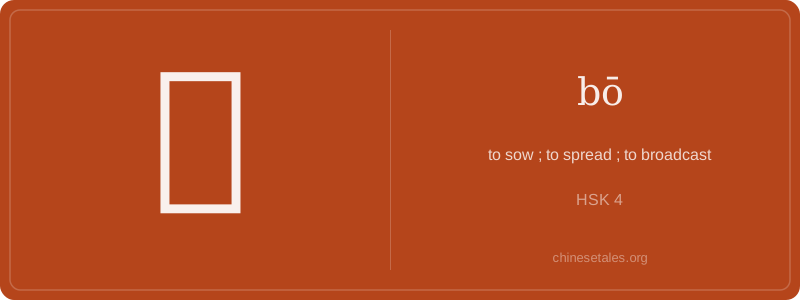
The earliest form of 播 appears in Han dynasty seal script: a hand radical (扌) gripping a stylized grain stalk with three seed-like dots — visualizing a farmer’s hand scattering seeds into furrows. Over centuries, the grain element evolved into the top-right component 波 (bō, 'wave'), not because of water, but due to phonetic borrowing: 波 shared the same pronunciation and was easier to write than the original complex seed glyph. The bottom part, 番 (fān), originally depicted a field with turning ploughs — reinforcing the agricultural root. By the Tang dynasty, the character stabilized into its modern structure: 扌 + 波 + 番 — a hand (action), wave (sound & motion), and field (context).
This visual evolution mirrors semantic expansion: from literal sowing in texts like the *Book of Songs* (‘播百谷’ — 'sow the hundred grains') to metaphorical dissemination — Mencius praised sages who '播仁义于天下' ('broadcast benevolence and righteousness throughout the realm'). By the Ming dynasty, 播 appeared in early printing terminology for distributing woodblock texts, foreshadowing its 20th-century leap into radio and TV. Crucially, the hand radical (扌) never left — anchoring every meaning in human agency: we don’t passively receive broadcasts; we actively播 them.
At its heart, 播 (bō) is about *intentional dispersion* — not random scattering, but purposeful sowing or broadcasting that carries hope, influence, or information across space and time. In Chinese thought, this reflects a deep cultural reverence for cultivation: whether planting rice in spring, spreading Confucian teachings across dynasties, or streaming a podcast today, the act implies care, timing, and faith in future growth. The character never means 'to dump' or 'to scatter recklessly' — that’s why 撒 (sā) exists for casual throwing.
Grammatically, 播 is versatile but selective: it’s transitive and almost always requires an object (e.g., 播种子, 播新闻, 播音). You can’t say *‘他播了’* alone — it feels incomplete, like saying 'He sowed...' and trailing off. It also rarely takes aspect particles like 了 or 过 directly after itself; instead, you’d say 播完了 or 已经播出了. Learners often overgeneralize it to mean 'play' (like playing music), but that’s 播放 (bōfàng) — using 播 alone for 'play' sounds archaic or poetic.
Culturally, 播 bridges ancient agrarian life and digital modernity: the same character appears in the 2nd-century dictionary *Shuōwén Jiězì*, defining it as ‘spreading seeds with hands’, and in today’s headlines like ‘直播’ (live broadcast). A common mistake? Using 播 when you mean ‘to distribute’ in bureaucratic contexts — that’s usually 发 (fā). Also, note its tone: bō (first tone), not bó or bò — mispronouncing it as ‘bó’ risks confusion with 薄 (thin) or 勃 (vigorous).