败
Character Story & Explanation
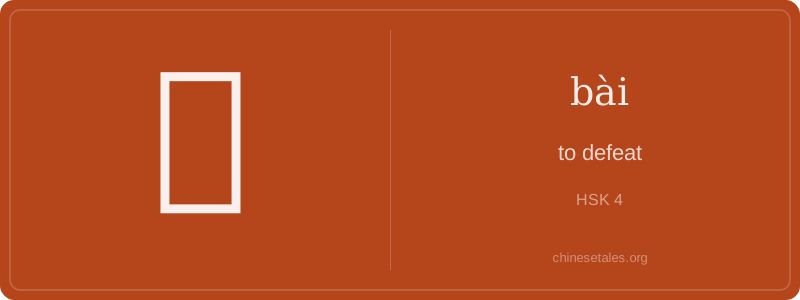
The earliest form of 败 appears in bronze inscriptions as a combination of 貝 (bèi, ‘cowrie shell’, symbolizing value/wealth) and 攵 (pū, a hand holding a stick — later evolving into 攵, ‘to strike’). Visually, it was a hand striking a shell — implying *the destruction of something valuable*, like smashing currency to signal economic collapse or spoiling treasure through negligence. Over centuries, the shell simplified into 贝 (the modern radical), and the striking hand became the right-side component 贝 + 攵 → 败, solidifying by the Han dynasty.
This origin explains everything: defeat isn’t abstract — it’s the *material ruin of worth*. In the Zuo Zhuan, 败 describes states collapsing after moral failure: ‘其国将败’ (‘their state will fall’), linking political downfall to ethical decay. The character’s visual logic — striking wealth — echoes in modern usage: 败家 (ruining family wealth), 败兴 (spoiling joy, i.e., destroying the ‘value’ of excitement), even 败血 (bàixuè, ‘sepsis’ — blood ‘spoiled’). Its shape is a warning: what you strike, you destroy — and what you destroy, matters.
At its heart, 败 (bài) isn’t just ‘to defeat’ — it’s about *loss with consequence*. Think of it as the moment a carefully built sandcastle collapses: irreversible, visible, and emotionally charged. Unlike neutral verbs like ‘lose’ (输 shū), 败 carries weight — military defeat, moral failure, or irreversible decay (e.g., 败坏 bàihuài ‘to corrupt’). It’s almost always transitive: you *cause* defeat — someone 败北 (bàiběi, ‘is defeated’) or 败下阵来 (bài xià zhèn lái, ‘steps down in defeat’).
Grammatically, it shines in resultative compounds and passive constructions. You’ll see it after verbs: 打败 (dǎbài, ‘beat up/defeat’) or 击败 (jībài, ‘overwhelm decisively’). Watch out — learners often misplace it: saying 我败了 (wǒ bài le) sounds oddly poetic or archaic; instead, use 我输了 (wǒ shū le) for casual loss, or 我被打败了 (wǒ bèi dǎbài le) for ‘I was defeated’. Also, 败 never stands alone as an adjective — you wouldn’t say ‘a defeated person’ using just 败; you’d use 失败的 (shībài de).
Culturally, 败 is loaded with Confucian gravity: to 败 is not just to lose — it’s to fall short of virtue, duty, or harmony. That’s why we say 败德 (bàidé, ‘moral failure’) or 败家 (bàijiā, ‘to ruin one’s family fortune’). A common mistake? Using 败 where 输 fits better — like scoring points in ping-pong. Save 败 for battles, exams, negotiations, or legacies.