暑
Character Story & Explanation
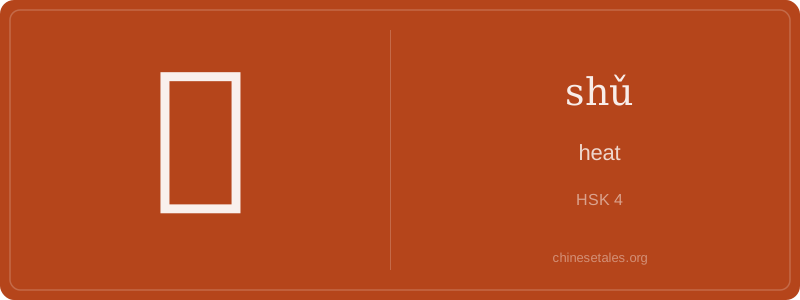
The earliest form of 暑 appears in Warring States bamboo texts as a complex ideograph: 日 (sun) at the top, then two stacked 'fire' components (灬, the 'four dots' radical) below, flanked by two hands () holding up a lid-like shape — visualizing heat trapped under a blazing sun, like steam rising from a covered wok. Over centuries, the hands simplified into 土 (tǔ, earth), and the double fire (灬) merged into the lower four-dot radical — giving us today’s structure: 日 + 者 (a phonetic component that also hints at 'presence' or 'manifestation').
This evolution reflects its meaning shift: from literal 'trapped solar heat' to the abstract, seasonal phenomenon of midsummer intensity. In the Book of Rites, 暑 appears in passages describing rituals to appease summer spirits — '暑者,熱之極也' ('Shǔ is the extreme of heat'). Its visual logic remains intact: the sun (日) dominates the top, while the lower part — 者 + 灬 — suggests 'that which manifests as scorching energy', making it one of Chinese writing’s most atmospherically precise heat characters.
Imagine stepping out of Beijing’s subway on a July afternoon — the air shimmers, your shirt sticks, and the metro attendant fans herself with a folded bus schedule while muttering, '这暑气太重了!' (zhè shǔ qì tài zhòng le!) — 'This summer heat is oppressive!' That’s 暑 in action: not just generic 'heat' like 热 (rè), but the thick, humid, seasonally charged heat of high summer — the kind that hangs in the air like wet silk. It’s poetic, atmospheric, and almost always appears in compound words or literary contexts, never alone as a verb or standalone noun.
Grammatically, 暑 rarely stands solo — you won’t say *‘我怕暑’* (I fear heat); instead, it anchors elegant compounds: 暑假 (shǔ jià, summer vacation), 中暑 (zhòng shǔ, heatstroke), 暑气 (shǔ qì, sultry air). Notice how it pairs with verbs like 中 (to be struck by) or nouns like 假 (vacation) — it’s a 'heat noun', not a 'heat verb'. Learners often mistakenly substitute 热 here, but saying *‘中热’* sounds like ‘struck by warmth’ — absurdly mild, even cozy!
Culturally, 暑 carries the weight of China’s agricultural calendar: the 24 solar terms include 小暑 (xiǎo shǔ, Minor Heat) and 大暑 (dà shǔ, Major Heat) — two critical markers signaling peak rice-planting and heat-related health vigilance. Mistaking 暑 for 熟 (shú, cooked) or 蜀 (shǔ, Sichuan) is common due to identical pinyin — but those are homophones with zero semantic overlap. Remember: 暑 is *sun + furnace*, not *Sichuan* or *cooked*.