友
Character Story & Explanation
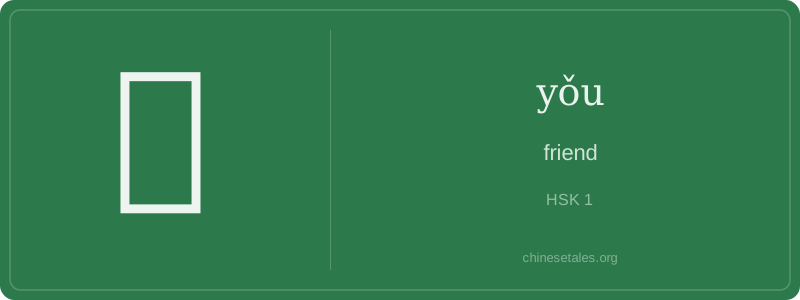
The earliest form of 友 appears in oracle bone inscriptions as two identical hands (又) facing each other — like two people clasping wrists or offering palms in greeting. Each hand was drawn with three fingers and a wrist line. Over time, one hand simplified into the modern 又 radical (top-left), while the second hand rotated and merged into the lower-right component — still clearly echoing two hands meeting. By the seal script era, the symmetry had softened into the clean, balanced four-stroke form we write today: 又 + 乛 (a gentle hook representing the second hand’s gesture).
This handshake wasn’t symbolic fluff — it embodied the ancient Chinese ideal of yǒu: mutual respect, voluntary alliance, and moral alignment. In the Analects, Confucius says, ‘Yǒu zhí, yǒu liáng, yǒu jian, sī sān yǒu yǐ’ (‘There are three kinds of friends who benefit you…’), elevating friendship to an ethical practice. Even today, the character’s shape whispers its origin: no hierarchy, no force — just two equal hands choosing to meet.
Imagine you’re at a Beijing university canteen, and your classmate Li Wei slides into the seat beside you, grinning, and pushes a steaming baozi toward you — no words needed. That unspoken warmth, that instant ease? That’s 友 (yǒu). It’s not just ‘friend’ as in a Facebook contact; it’s someone you trust enough to share food, silence, or a borrowed eraser — deeply relational, quietly loyal, and always mutual.
Grammatically, 友 is almost never used alone. You’ll rarely hear someone say *‘Wǒ yǒu yǒu!’* — that sounds like saying ‘I have friend!’ in English. Instead, it lives inside compound words: péngyǒu (friend), hǎoyǒu (good friend), or even as a suffix in jiāoyǒu (to make friends). It can also appear in formal contexts like ‘guójì yǒuhǎo’ (international friendship) — where it carries diplomatic weight far beyond casual banter.
Culturally, 友 implies reciprocity and shared values — Confucius ranked ‘friendship’ (yǒu) as one of the Five Cardinal Relationships, right after ruler-subject and parent-child. Learners often mistakenly use 友 as a standalone noun like ‘friend’ in English, or confuse it with péng (as in péngyǒu), not realizing that 友 alone feels stiff or literary — like saying ‘thou art my comrade’ instead of ‘you’re my buddy’. Also, it’s never used for romantic partners — that’s liàn rén or ài rén, never yǒu.