暂
Character Story & Explanation
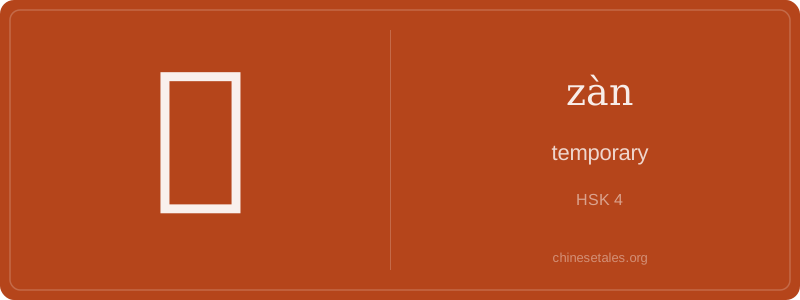
The earliest form of 暂 appears in Han dynasty clerical script, not oracle bone — and its origin is delightfully literal. The left side 日 (rì, ‘sun/day’) anchors it in time, while the right side 斩 (zhǎn, ‘to chop, sever’) was originally written with 戊 (a battle-axe) + 车 (chariot), evolving into today’s simplified 斩. Together, they evoke ‘cutting off a span of time’ — like slicing a segment from the sun’s daily arc. Visually, the 12 strokes mimic that precision: the top 日 is compact and stable; the bottom 斩’s sharp diagonal strokes (the ‘chopping’ motion) slash downward — no gentle fade-out, just decisive temporal truncation.
This ‘time-chopping’ metaphor solidified in classical texts: in the Shuō Wén Jiě Zì (121 CE), Xu Shen defined 暂 as ‘a brief moment — like the flash of a sword drawn and sheathed’. By Tang poetry, it carried poetic weight: Li Bai used 暂 in ‘暂伴月将影’ (‘for now, I keep company with moon and shadow’), underscoring the fragility of joy. Crucially, 暂 never meant ‘soon’ or ‘eventually’ — always ‘bounded brevity’. Its visual duality — sun (enduring) + axe (violent interruption) — mirrors its semantic tension: time marked not by flow, but by deliberate, temporary severance.
Imagine you’re rushing through Beijing Railway Station, breathless, clutching a crumpled ticket — your train departs in 8 minutes. A staff member points to a sign: 暂 停 服 务 (zàn tíng fú wù). You freeze: ‘Temporary service suspension’? Not ‘permanent’ — not ‘cancelled’ — but *just for now*. That’s 暂 in action: it doesn’t whisper ‘brief’; it *insists* on impermanence, like a hand briefly hovering over a light switch — on, then off, with no promise of return. It’s the linguistic equivalent of a pause button, never delete.
Grammatically, 暂 is almost always an adverb — it modifies verbs directly, never stands alone as a noun or adjective. You say 暂住 (zàn zhù, ‘temporarily reside’), not ‘暂的住’. Learners often mistakenly treat it like English ‘temporary’ and try to use it attributively (e.g., *‘暂房子’* — wrong!). Also, avoid pairing it with perfective aspect particles like 了 after the verb — it clashes with finality: *‘他暂走了’* sounds deeply unnatural. Instead, use it before the verb: 他暂不参加会议 (He will *not attend the meeting for now*).
Culturally, 暂 carries a subtle air of bureaucratic grace — it softens refusals and delays without sounding dismissive. In official notices, it implies control and intentionality: this isn’t chaos; it’s a planned, bounded pause. Foreigners sometimes overuse it trying to sound formal, but native speakers reserve it for contexts where transience is *institutionally acknowledged* — transit, administration, tech interfaces — not casual plans like ‘I’ll be back in 5 mins’ (that’s just 一会儿).