歉
Character Story & Explanation
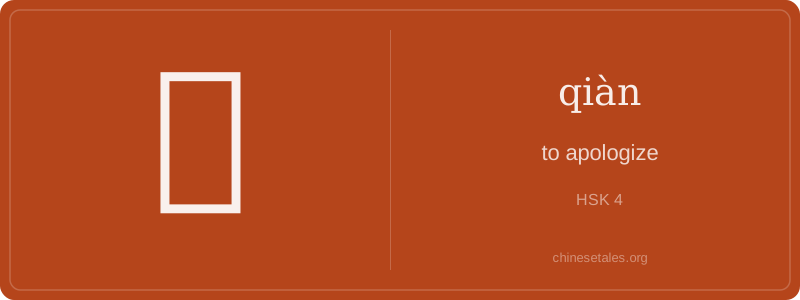
The earliest form of 歉 appears in seal script (c. 3rd century BCE), built from two clear components: the left side 欠 — a pictograph of a person with mouth open, suggesting sighing, breathing out, or even yawning (later generalized to ‘lack’ or ‘deficiency’); and the right side 谦 — which itself evolved from a phonetic component combining 兼 (jiān, ‘to hold both’) and 言 (yán, ‘speech’), hinting at ‘humble speech’. Over centuries, the top part simplified from 兼 to 兼’s cursive variant, and the bottom 言 lost its full dot-and-hook structure, becoming the compact 又-like shape we see today — all 14 strokes now flowing in disciplined sequence: start with the radical 欠, then trace the balanced, slightly bowed right half.
This visual duality — ‘lack’ + ‘humble speech’ — perfectly mirrors its semantic evolution. In classical texts like the Xunzi, 歉 was used not only for apology but also for ‘feeling insufficient’ or ‘being humble in conduct’. By the Tang dynasty, it had crystallized into its modern sense: the verbal act of acknowledging one’s moral shortfall. The character doesn’t depict bowing or kneeling — unlike 礼 (lǐ, ‘ritual’) — but rather the internal posture: breath drawn low, voice softened, words measured. It’s apology as quiet recalibration, not performative penance.
At its heart, 歉 isn’t just ‘to apologize’ — it’s the quiet weight of moral accountability. In Chinese, saying 歉 feels less like checking a box and more like acknowledging a tear in the social fabric; the character carries the soft gravity of humility, not guilt. You’ll almost never see it alone: it’s always bundled — as part of compounds like 道歉 (dào qiàn, 'to make an apology') or 抱歉 (bào qiàn, 'I’m sorry'). It doesn’t function as a verb on its own like English ‘apologize’ — you wouldn’t say *‘我歉你’; instead, you say 我向你道歉 or 我很抱歉. That preposition matters: apology in Chinese is relational, directional, and often mediated by ritual phrases.
Learners frequently overuse 歉 as a standalone verb or misplace it in sentence structure — a classic HSK-4 trap. Also, note that 歉 is almost exclusively used in formal or emotionally sincere contexts; you’d never text a friend ‘抱歉’ for being 2 minutes late — you’d use 对不起 (duì bu qǐ), which is lighter and more colloquial. 歉 appears where sincerity needs anchoring: official letters, workplace emails, or when addressing elders or superiors. Its presence signals that the speaker has paused, reflected, and chosen respect over convenience.
Culturally, 歉 reflects Confucian ideals of self-cultivation through moral awareness — the character itself embodies ‘recognizing one’s shortfall’ (the radical 欠 means ‘lack’ or ‘debt’). Interestingly, while English apologizes *for* something, Chinese often apologizes *to* someone *for* something — and 歉-based phrases embed that hierarchy naturally. Miss this nuance, and your apology may sound oddly detached — like handing over a receipt instead of offering a bow.