沙
Character Story & Explanation
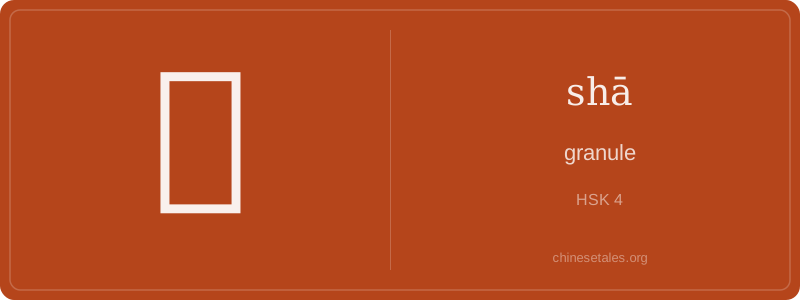
The earliest form of 沙 appears in Warring States bamboo slips as a left-right structure: the left side was 水 (shuǐ, water), simplified later to 氵; the right was 少 (shǎo, few, little). Originally, it wasn’t about ‘sand’ per se — it depicted *small particles suspended in water*, like silt or sediment. Over centuries, the water radical stayed to signal ‘flowing matter’, while 少 evolved from a pictograph of small grains into its modern shape — three dots (丶) above a vertical stroke, visually echoing scattered granules. By the Han dynasty, the character stabilized into today’s seven-stroke form: three dots of water on the left, then 少 with its distinctive ‘dot-dot-vertical’ top.
This visual logic shaped its meaning: from ‘suspended fine particles’ → ‘dry granular matter’ → ‘sand’. Classical texts like the Book of Songs used it poetically: ‘淇水滺滺,檜楫松舟;駕言出游,以寫我憂。… 淇則有岸,隰則有泮。… 淇水湯湯,漸車帷裳。… 淇水悠悠,檜楫松舟。’ — though 沙 itself doesn’t appear there, later commentaries describe riverbanks where ‘shā accumulates where water slows’. The character’s duality — water radical + ‘few’ — quietly encodes a profound truth: what seems solid (sand) emerges precisely where flow pauses.
At its heart, 沙 (shā) isn’t just ‘sand’ — it’s the *feeling* of granules: tiny, dry, shifting, slightly resistant. Think of running your fingers through beach sand versus wet clay: 沙 evokes that light, gritty, dispersible quality. That’s why it appears not only in physical nouns like 沙漠 (shāmò, desert) but also in abstract compounds like 沙龍 (shālóng, salon — originally borrowed from French 'salon', but the Chinese chose 沙 because early Western salons were held in elegant, 'grainy'-textured rooms? Not quite — but learners love remembering that! In truth, it was phonetic borrowing: 'sa' + 'long'. Still, the character stuck, and now feels perfectly at home.
Grammatically, 沙 is almost always a noun or part of a compound noun — it rarely stands alone in modern speech (you’d say 沙子 shāzi for ‘a grain of sand’, not just 沙). It never functions as a verb or adjective. A common mistake? Using 沙 instead of 泥 (ní, mud) when describing wet, sticky earth — they’re opposites in texture! Also, watch tone: shā (first tone) is standard; shà appears only in rare literary or dialectal contexts like 沙沙 (shāshā, rustling sound of wind through leaves), where reduplication mimics soft granular noise.
Culturally, 沙 carries quiet weight: the Gobi Desert (戈壁沙漠 gēbì shāmò) symbolizes endurance; the idiom 飞沙走石 (fēi shā zǒu shí, ‘flying sand, rolling stones’) paints chaos and unstoppable force. Learners often misread the radical 氵 as implying water — but here it hints at *flow*, not liquid: sand flows like water, yet resists it. That paradox — dry yet fluid — is the soul of 沙.