况
Character Story & Explanation
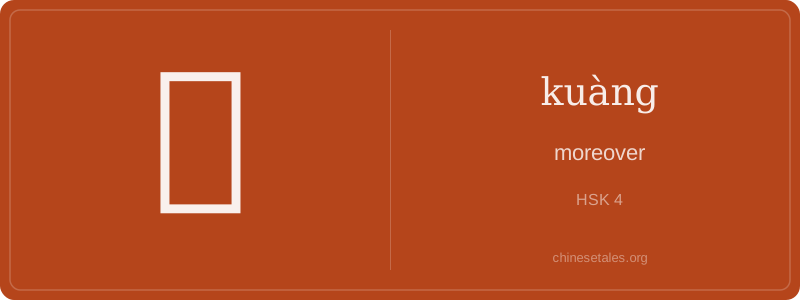
The earliest form of 况 appears in Warring States bamboo slips as a compound character: left side 冫 (bīng, 'ice') + right side 兄 (xiōng, 'elder brother'). But here’s the twist — the 'brother' wasn’t about kinship. In ancient bronzeware script, 兄 was originally a pictograph of a *person kneeling before an ancestral altar*, symbolizing reverence and ritual context. Paired with 冫 — which conveyed 'clarity', 'coolness', or 'detached judgment' (like ice reflecting truth without distortion) — the whole character evoked 'a clear, sober assessment within a formal setting'. Over centuries, the right side simplified from the full kneeling figure to today’s 兄, and the left froze into the two-dot 冫 radical.
This visual logic shaped its meaning: 况 came to signify 'to consider something *in light of* a prior fact' — i.e., 'moreover, given that…'. By the Han dynasty, it appeared in texts like the *Huainanzi* to introduce layered reasoning: 'The ruler is wise; 况 his advisors are loyal?' — implying a deeper, almost self-evident corollary. The ice-brother combo thus became a metaphor for calm, contextual evaluation — not emotional reaction, but cool-headed extension of logic. Even today, the character feels 'frosty' in tone: precise, unemotional, and structurally indispensable in formal argumentation.
Think of 况 (kuàng) as the Chinese equivalent of a raised eyebrow paired with a thoughtful pause — not quite a full sentence, but a rhetorical nudge that says, 'And *by the way*, there’s more to consider.' It doesn’t stand alone like 'however' or 'but'; instead, it glues ideas together with quiet emphasis, often introducing an even stronger or more surprising point — much like saying 'Moreover...' mid-argument in English, right before dropping a clincher. It’s formal, literary, and rarely used in casual speech — you’ll spot it in essays, news headlines, and academic writing, never in WeChat chats.
Grammatically, 况 is almost always followed by 且 (qiě), forming the fixed conjunction 况且 (kuàngqiě), meaning 'moreover' or 'besides.' You won’t say *'kuàng this'* — it needs that partner, like a duet where 况 opens the phrase and 且 completes the rhythm. A common mistake? Trying to use 况 alone ('*Tā hěn máng, kuàng…*') — that’s incomplete and jarring. Also, learners sometimes misplace it: it introduces new information *after* the main clause, never before ('He’s tired; *moreover*, he hasn’t slept in 36 hours' — not 'Moreover, he’s tired...').
Culturally, 况 carries a subtle tone of reasoned escalation — it signals logical progression, not emotion. Unlike 啊 or 呀, it doesn’t soften or warm; it sharpens. Native speakers use it to build gravity, especially when stacking evidence or justifying conclusions. That’s why it appears so often in policy documents and editorial commentary: it’s the linguistic equivalent of tapping your pen twice on the table for emphasis — precise, restrained, and deeply persuasive.