消
Character Story & Explanation
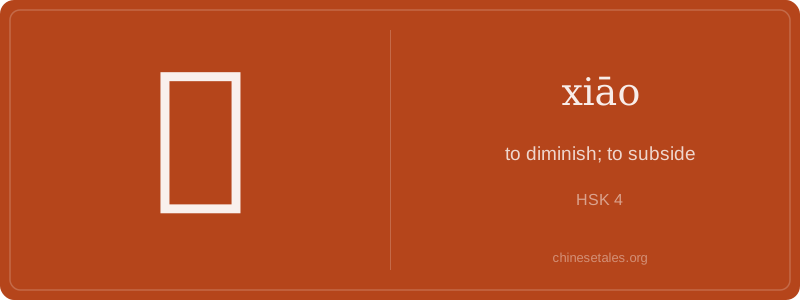
The earliest form of 消 appears in bronze inscriptions as a combination of 氵 (water) on the left and 少 (shǎo, ‘few, little’) on the right — no fire, no sun, just water and scarcity. Think of water slowly evaporating from a shallow dish: the liquid level drops, volume lessens, presence fades. Over centuries, the right-hand component evolved from 少 into the modern 殳 (shū, a hand holding a weapon), likely due to phonetic borrowing — since 少 and 消 shared similar ancient pronunciations. Yet the water radical remained central, anchoring the meaning in fluidity and change.
This visual logic held firm: water diminishes — so do fevers, debts, and misunderstandings. In the Book of Changes (Yì Jīng), 消 describes the quiet retreat of yang energy during autumn — not collapse, but graceful subsidence. By the Tang dynasty, poets like Bai Juyi used 消 to evoke time’s gentle erosion: ‘愁多酒虽少,酒尽愁不消’ (‘Though sorrow is great and wine scarce, when wine ends, sorrow does not subside’). The character never lost its core sense: *reduction through natural process*, always tied to flow, time, or transformation — never brute force.
Imagine you’re watching steam rise from a hot cup of tea on a cold morning — it doesn’t vanish into nothing, but *dissipates*, thins, and gradually disappears into the air. That gentle, inevitable fading is exactly what 消 (xiāo) captures: not violent destruction, but quiet diminishment — heat, tension, time, or even suspicion. It’s the soft sigh after stress, the slow retreat of fever, the fading of rumors. Unlike 灭 (miè, ‘to extinguish’) or 毁 (huǐ, ‘to destroy’), 消 implies natural, often gradual reduction — and crucially, it’s almost always used transitively: something *causes* the diminishing (e.g., 吃药消炎 — ‘take medicine to reduce inflammation’).
Grammatically, 消 appears in many common patterns: with -化 (xiāo huà, ‘to eliminate’), in compound verbs like 消失 (xiāo shī, ‘to disappear’), and especially in the ‘xiāo + noun’ structure meaning ‘to reduce/relieve [X]’: 消肿 (reduce swelling), 消愁 (dispel sorrow), 消防 (fire prevention — literally ‘eliminate fire’). Learners often mistakenly use it where they mean ‘to spend’ (花 huā) — you don’t 消钱; you 花钱. Also, avoid using 消 alone as a verb — it nearly always appears in compounds or with an object.
Culturally, 消 carries subtle Daoist resonance: it reflects the idea of things naturally returning to stillness — like water settling or mist clearing. In classical texts, 消 often pairs with 长 (zhǎng, ‘to grow’) in the phrase 消长 (xiāo zhǎng), describing cyclical waxing and waning (tides, fortunes, yin-yang). Modern usage preserves this balance: we say 消费 (xiāo fèi, ‘consume’) not because money vanishes, but because resources *diminish* through use — a quietly philosophical take on economics.