汤
Character Story & Explanation
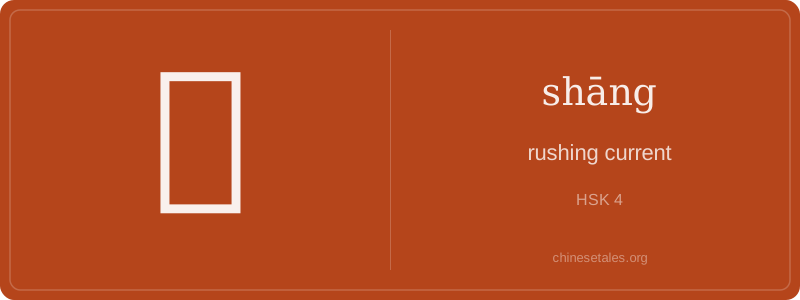
The earliest form of 汤 appears in bronze inscriptions as a flowing, three-pronged water symbol (氵) beside a phonetic component 丿 + 昜 — where 昜 (yáng) depicted the sun rising over a hill, suggesting brightness and movement. Over time, the water radical stabilized into the modern three-dot left-hand form 氵, while 昜 simplified to + 日 → eventually becoming the right-hand component of today’s 汤. Visually, it’s water (氵) + energy (from 昜’s solar dynamism) — perfectly capturing water in forceful, luminous motion.
This visual logic shaped its meaning for millennia. In the *Book of Songs* (Shījīng), 汤 describes the Yellow River’s mighty flow: ‘河水汤汤,逝者如斯’ — ‘The river flows shāng shāng; the departed are like this.’ By the Han dynasty, it was already fossilized in literary compounds, preserving its archaic vigor while everyday speech shifted to tāng for ‘soup’. The character thus became a linguistic time capsule — holding the ancient roar of rivers in a shape we now associate with steaming bowls.
Imagine standing on a narrow stone bridge at dawn, watching the Yellow River surge past — not gently, but with raw, churning power: water crashing against rocks, foam flying, current so strong it seems to roar. That’s 汤 (shāng): not soup, not broth, but the ancient, visceral image of water in violent, unstoppable motion. In classical Chinese, 汤 *only* meant this — a rushing, boiling, turbulent current (think ‘torrent’ or ‘roiling stream’). You’ll still see it in poetic or literary contexts like 汤汤 (shāng shāng) — an onomatopoeic reduplication meaning ‘gushing noisily’, as in ‘the river flows shāng shāng’.
Grammatically, 汤 (shāng) is almost always found in fixed classical compounds — never alone in modern speech. It’s a literary relic, so learners won’t use it conversationally, but they *will* encounter it in HSK 4+ reading: idioms like 浩浩汤汤 (hào hào shāng shāng, ‘vast and surging’) or place names like 汤阴 (Tāngyīn — note the tone shift!). Crucially: don’t confuse its literary shāng pronunciation with the far more common tāng (‘soup’); that’s a homophone from a completely different etymological root — same character, divergent paths.
Culturally, this duality trips up even advanced learners: seeing 汤 in text and defaulting to ‘soup’ leads to hilarious mistranslations (e.g., mistaking ‘汤汤流水’ as ‘soup-soup flowing water’!). The key is tone + context: if it’s reduplicated, poetic, or paired with words like 浩浩 or 滔滔, it’s shāng — water in motion. If it’s in a menu, kitchen, or health context (‘chicken soup’), it’s tāng. Mastering this split isn’t just linguistic — it’s stepping into two distinct layers of Chinese language history.