泼
Character Story & Explanation
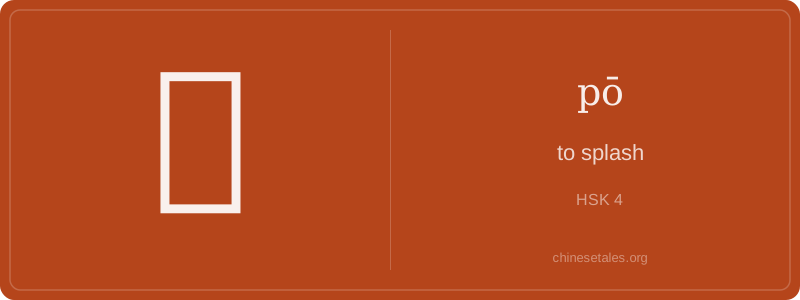
The earliest form of 泼 appears in seal script (~3rd c. BCE), combining 氵 (three dots representing flowing water) on the left with 發 (fā, ‘to emit, launch’) on the right—later simplified to 发. The original 發 itself depicted a hand releasing arrows from a bow, symbolizing forceful projection. Over time, the arrowhead became abstracted into the top dot and cross stroke (癶), and the hand (又) evolved into the bottom component. By the Song dynasty, the modern shape 泼 emerged: three water dots anchoring a compact, energetic 发—visually echoing water hurled outward by deliberate action.
This evolution mirrors its semantic journey: from classical texts like the Shuōwén Jiězì (121 CE), which defined it narrowly as ‘to scatter liquid’, to Tang poetry where poets used 泼墨 to describe expressive ink-splash techniques in landscape painting—turning physical action into aesthetic philosophy. By the Ming-Qing era, 泼 had metaphorically expanded to describe bold personality (泼辣) and even rhetorical force (泼冷水, ‘splash cold water’ = to discourage). Its visual duality—water + emission—makes it a perfect vessel for both literal splash and figurative zeal.
At its core, 泼 (pō) isn’t just about water flying—it’s about *unrestrained energy*. Think of a child flinging paint, a chef tossing oil into a wok with a sizzle, or someone ‘splashing’ sarcasm in conversation. In Chinese, this verb carries an almost tactile sense of force and spontaneity: it implies motion outward, often with abandon or intensity—not gentle dripping, but bold, uncontained release.
Grammatically, 泼 is a transitive verb that usually takes a direct object (e.g., 泼水 ‘splash water’) and commonly appears in serial verb constructions like 泼出去 (pō chūqù, ‘splash out’) or with aspect particles: 泼了 (pō le, ‘has splashed’). Learners often mistakenly use it for passive or accidental spills—‘the cup fell and water spilled’ is better as 水洒了 (shuǐ sǎ le), not 水泼了—because 泼 requires intentional or forceful agency. Also, note it’s rarely used alone; you’ll almost always see it paired: 泼墨 (pō mò, ‘splash ink’), 泼辣 (pō là, ‘spicy-and-bold’).
Culturally, 泼 reveals how Chinese values dynamism *within form*: the radical 氵 (water) grounds it in nature, yet the right side 发 (fā, ‘to emit’) hints at controlled eruption—like ink painting, where master artists ‘splash’ ink with disciplined wildness. A common learner trap? Confusing it with 瀑 (pù, ‘waterfall’)—which is static and majestic, while 泼 is active and human-driven.