熟
Character Story & Explanation
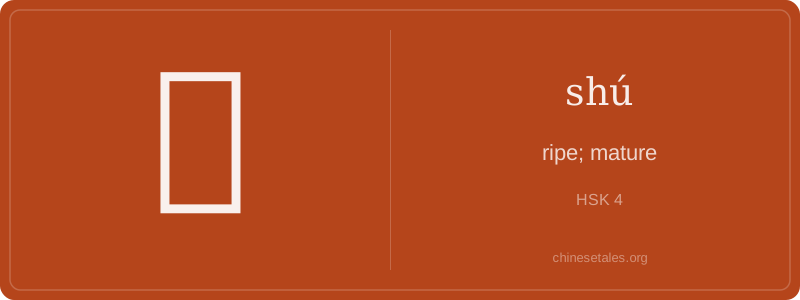
The earliest form of 熟 appears in bronze inscriptions as a compound: on the left, 米 (mǐ, uncooked rice), and on the right, a simplified version of 舌 (shé, tongue) — but crucially, with four dots beneath, evolving from 火 (huǒ, fire). Over centuries, the tongue shape morphed into 羽 (yǔ, feather) and then into the modern 熟, while the four dots solidified into the radical 灬 — the ‘fire’ radical indicating heat-driven change. So visually, it’s ‘rice + fire’ — literally ‘rice cooked until ready to eat’.
This literal origin expanded metaphorically by the Warring States period: in the *Zuo Zhuan*, 熟 describes both ‘ripened grain’ and ‘well-considered plans’ — implying thoroughness and readiness. By the Tang dynasty, poets like Du Fu used 熟 to describe ‘familiar landscapes’ and ‘mastered brushwork’. The fire radical remained the silent engine: whether fruit softening in sun, rice steaming in a pot, or knowledge settling in the mind, 熟 always signals *completion via transformative process* — never accidental, always earned.
Imagine you’re at a bustling Beijing fruit market in late summer. A vendor proudly holds up a peach — golden, velvety, slightly soft to the touch — and declares, 'Zhè ge táozi hěn shú!' (This peach is very ripe!). That ‘shú’ isn’t just about sugar content; it’s a sensory promise: sweet, yielding, ready — the culmination of time and care. In Chinese, 熟 carries this full-bodied sense of *readiness through transformation*: food cooked, fruit ripened, skills mastered, relationships deepened. It’s never passive — something becomes 熟 only after undergoing change.
Grammatically, 熟 shines as an adjective (shú ‘ripe/mature’) and verb (shú ‘to become familiar’ or ‘to master’), often paired with 得 (de) for degree: ‘tā duì zhè ge dìfāng hěn shú’ (He’s very familiar with this place). Learners sometimes overuse it for ‘cooked’ — but while 熟 *can* mean ‘cooked’, native speakers prefer 熟的 for food and 熟练/熟悉 for skills/familiarity. Confusingly, 熟 doesn’t mean ‘raw’ — that’s 生 (shēng) — and it’s never used for ‘unfamiliar’ (that’s 不熟, not *shū*).
Culturally, 熟 reflects the Confucian value of cultivation: mastery isn’t innate, it’s earned. You don’t just *know* a person — you become 熟 with them through repeated, meaningful contact. Mispronouncing it as shū (a common slip) makes zero sense — there’s no such reading in standard Mandarin. And watch that radical: 灬 (fire dots) hints at cooking heat, anchoring its core idea of *transformation by fire or time*.