尔
Character Story & Explanation
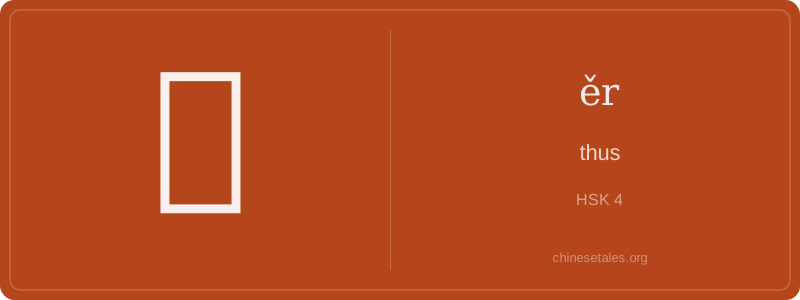
The earliest form of 尔 appears in Western Zhou bronze inscriptions as a simplified pictograph resembling two small strokes above a base — not a full picture of anything concrete, but a stylized abbreviation of 爾 (the traditional form), which itself evolved from an oracle bone glyph depicting ‘tassels hanging down’ (suggesting ornamentation, distinction, or even ‘that one there’). Over centuries, scribes streamlined 爾’s 14 strokes into the lean, minimalist 尔 we use today: just five strokes — two dots (丶丶), a short slant (丿), a hook (乚), and a final dot (丶) — all anchored under the 小 (xiǎo, ‘small’) radical, hinting at its origin as a diminutive or emphatic marker.
This visual reduction mirrors its semantic journey: from Old Chinese pronoun ‘you’ (as in 尔曹, ‘you all’) to Classical Chinese adverbial ‘thus, thereby’ — a shift from pointing outward (‘you’) to pointing inward (‘in this way’). Confucius used 尔 in the Analects (e.g., ‘君子坦荡荡,小人长戚戚。尔其慎之!’) to add solemn emphasis — ‘Thus, beware!’ Its elegance made it a favorite in parallel couplets and philosophical summations, where brevity carried moral authority. Even today, its shape — small yet precise — echoes its function: a tiny pivot turning logic into insight.
Think of 尔 (ěr) as Chinese’s elegant, slightly archaic ‘thus’ — like the word ‘wherefore’ in Shakespearean English: it signals logical consequence or conclusion, but with a quiet, literary gravitas. It doesn’t shout ‘therefore!’ like 所以 (suǒyǐ); instead, it leans in, whispering ‘and so it follows…’ — often in classical allusions, formal writing, or poetic parallelism. You’ll rarely hear it in daily chat, but you’ll see it in idioms, proverbs, and academic essays where tone matters.
Grammatically, 尔 functions as a conjunction or adverb — never a pronoun in modern usage (unlike its ancient role meaning ‘you’). In sentences like ‘事已至此,尔何言哉?’ (shì yǐ zhì cǐ, ěr hé yán zāi?), it bridges cause and rhetorical question: ‘The matter has reached this point — thus, what else is there to say?’ Notice how it sits crisply before the clause it introduces — no particles needed, no subject-verb fuss. Learners often misplace it or overuse it trying to sound ‘more Chinese’, but native speakers reserve it for deliberate stylistic weight.
Culturally, 尔 carries the hush of classical literacy — it’s the character you’d find inked on a scholar’s fan or quoted in a calligraphy exhibition. A common mistake? Confusing it with 耳 (ěr, ‘ear’) — same pronunciation, totally different radical and meaning. Also, don’t mix it up with 尔 (as in 尔等, ěr děng, ‘you people’) — yes, that’s the *same character*, but context flips it from ‘thus’ to archaic ‘you’. That duality is part of its charm — and its trap.