甚
Character Story & Explanation
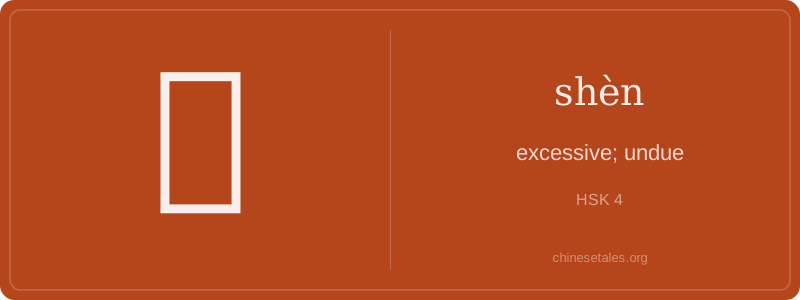
The earliest form of 甚, found on Western Zhou bronze inscriptions, was a vivid pictograph: a person kneeling before a cooking vessel (the precursor to 甘, 'sweet/delicious'), with a hand holding a ladle above it — suggesting someone *over-serving*, *over-indulging*, or *going too far* in offering food. Over centuries, the figure simplified, the ladle became the top horizontal stroke and dot, and the vessel evolved into the 甘 radical — now looking like a box with a crossbar, but still evoking containment and measured portioning. By the seal script era, the structure stabilized: the top element (亠 + 一 + 丷) fused into a stylized 'lid', and 甘 remained firmly rooted below — nine strokes total, balanced yet charged with implication.
This visual logic shaped its meaning: excess wasn’t abstract — it was visceral, culinary, social. In the Analects (11.26), Confucius critiques a disciple’s mourning as 'too intense' — using 甚 to question emotional overreach. Later, in Tang poetry, 甚 appears in lines like '山高水甚长' ('mountains high, waters *excessively* long'), where it adds lyrical gravity, not mere quantity. The character’s form — a lid pressing down on sweetness — quietly reminds us: even pleasure needs limits. That ancient kitchen scene still simmers beneath every modern usage.
At its heart, 甚 doesn’t just mean 'excessive' — it carries a quiet moral weight, like a raised eyebrow from your grandmother. In classical Chinese, it often appeared in rhetorical questions ('How could this be?') or as an intensifier meaning 'to what extent?' — signaling not just degree, but *appropriateness*. Modern usage retains that subtle judgment: saying 过于甚 (guòyú shèn) isn’t neutral — it implies something has crossed a line of propriety or balance, echoing Confucian ideals where harmony lies in the middle way, never at extremes.
Grammatically, 甚 rarely stands alone. It’s most common in fixed expressions like 不甚 (bù shèn, 'not very...'), as in 不甚满意 (bù shèn mǎnyì — 'not very satisfied'), where it softens criticism with polite restraint — a hallmark of Chinese communicative style. Learners often mistakenly use it like English 'very' (e.g., *甚高兴), but that’s archaic or literary; today, it only works in set phrases or formal writing. You’ll almost never hear it in casual speech outside idioms.
Culturally, 甚 reflects a deep-seated suspicion of extremity — whether in emotion, behavior, or rhetoric. Its frequent pairing with negation (不甚, 未甚, 非甚) reveals a linguistic preference for moderation and understatement. A common error is confusing it with 甚麼 (shénme, 'what'), but note: that’s a *different character* (甚 + 么) — and the 甚 there is purely phonetic, stripped of its original 'excess' meaning. That semantic drift itself tells a story about how Chinese repurposes characters with elegant pragmatism.