础
Character Story & Explanation
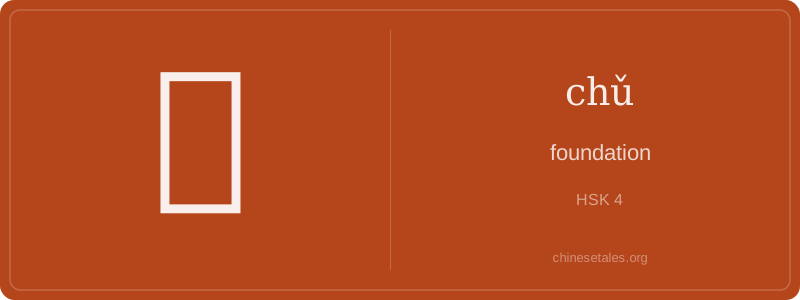
The earliest form of 础 appears in Han dynasty seal script — not oracle bones, since this character emerged later — as a clear combination: the radical 石 (shí, 'stone') on the left, and 楚 (chǔ) on the right. 楚 itself originally depicted thorny bushes (林 + 足, suggesting 'bushes one walks through'), and was borrowed phonetically here. So visually, 础 is 'stone' + 'Chǔ' (a place name and sound cue) — no pictograph of a pillar base, but a clever phono-semantic compound where the right side gives pronunciation, not meaning. Its ten strokes settled early: four for 石, six for 楚 — clean, balanced, and solid-looking, just like the thing it names.
By the Tang and Song dynasties, 础 was already entrenched in architectural terminology and poetic metaphor. Du Fu wrote of ‘pillar bases worn smooth by centuries’ — referring literally to stone plinths eroded by rain and time, symbolizing endurance. In classical texts, 础 often appears in parallel with 柱 (zhù, 'pillar') — the base and the upright, inseparable as yin and yang. Even today, when architects restore ancient temples, they measure the original 础 stones first — because everything else rises from them. That visual logic — stone at the bottom, bearing all — never changed.
At its heart, 础 (chǔ) isn’t just 'foundation' in the abstract — it’s the literal stone base that bears the weight of ancient Chinese architecture: the massive, often carved, plinth beneath a pillar or column. This physicality matters deeply in Chinese thought — foundations aren’t theoretical; they’re heavy, unyielding, and deliberately hidden yet absolutely indispensable. You’ll rarely hear someone say 'my foundation is strong' casually; instead, 础 appears in formal, literary, or metaphorical contexts — like describing the 'foundation of a nation' or 'foundation of trust' — always carrying quiet gravity and permanence.
Grammatically, 础 is almost never used alone. It’s strictly a noun and appears only in compound words (e.g., 基础, 根础). You won’t say *‘zhè shì chǔ’* — that would sound bizarre, like saying 'this is a plinth' in English when you mean 'this is the basis.' Instead, it pairs with other nouns: 基础 (jīchǔ) is by far the most common — so much so that many learners think 基础 *is* the word for 'foundation,' not realizing 础 is its irreplaceable, stone-hearted core.
A classic learner trap? Pronouncing it as 'chū' (like 初) — but chǔ has a falling-rising tone (third tone), mirroring its weighty, grounded nature. Also, because 础 looks similar to 拙 (zhuō, 'clumsy') or 确 (què, 'certain'), beginners sometimes misread texts — especially in classical-style phrases where 础 appears without its usual partner 基. Remember: if you see 石 + 楚, it’s always chǔ, always stone, always foundational.