程
Character Story & Explanation
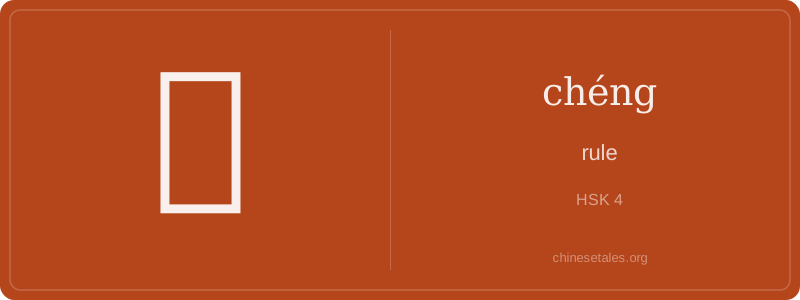
The earliest form of 程 appears in bronze inscriptions as a compound: left side was 禾 (hé, 'grain'), representing cultivated land and measurement (since grain fields were surveyed precisely), and right side was 呈 (chéng, 'to present'), which itself combined 口 (mouth) and 王 (king) — symbolizing official presentation to authority. Over centuries, the right side simplified into 呈’s top part (the 'sun' radical 日) plus the lower strokes, merging into today’s 呈-like shape. Crucially, the ‘禾’ radical stayed front-and-center — anchoring the character in agriculture, land division, and by extension, standardized units of length and time.
This visual origin explains everything: ancient Chinese surveyors measured distances between grain-growing regions using fixed units — those became 'standards' (程). By the Warring States period, texts like the *Mozi* used 程 to mean 'standard of measurement', and by the Han dynasty, it broadened to 'procedure' in legal and bureaucratic contexts. The character’s enduring logic is elegant: if you can measure a field, you can measure a process — both require defined boundaries, consistent units, and reproducible steps. It’s not top-down decree; it’s bottom-up order born from observation.
At its heart, 程 (chéng) isn’t just 'rule' — it’s the quiet authority of a measured standard: the fixed distance between milestones on an ancient road, the precise steps in a ritual, the non-negotiable sequence in a process. Its core feeling is *structured progression*: not arbitrary law, but an observable, repeatable path that things must follow to be legitimate — think 'procedure', 'course', or 'benchmark'. That’s why you’ll see it in words like 工程 (gōng chéng, 'engineering project') — literally 'work + course' — where every phase follows an approved plan.
Grammatically, 程 rarely stands alone as a noun meaning 'rule'; instead, it thrives in compounds and abstract nouns indicating scope, stage, or method. Learners often mistakenly try to use it like 规则 (guīzé, 'rule') — saying *'chéng shì'* for 'this is a rule' — but that’s unnatural. Instead, it appears in set phrases like 进程 (jìn chéng, 'progress'), 程序 (chéng xù, 'procedure'), or 按照程序 (àn zhào chéng xù, 'according to procedure'). Notice how it’s almost always paired — it’s a team player, not a solo act.
Culturally, 程 carries Confucian undertones of orderly conduct: a 'proper course' reflects harmony and due process. A common slip is mispronouncing it as chěng (third tone), but it’s always chéng (second tone) — like 'cheng' in 'Chengdu', carrying a steady, rising cadence. And yes, despite its 'rule' gloss, it’s never used for moral commandments (that’s 令 lìng or 法 fǎ); it’s about *how* things unfold, not *what* you must do.