究
Character Story & Explanation
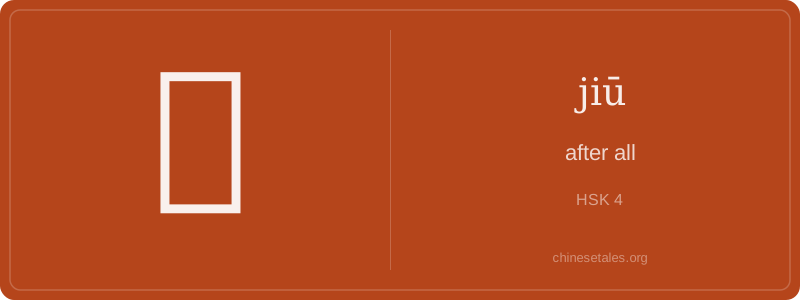
The earliest form of 究 appears in bronze inscriptions as a combination of 宀 (roof, later evolving into 穴) over 九 — not random: 九 was both a phonetic clue (ancient pronunciation close to *kiu*) and a symbol of ‘completion’ or ‘extremity’ (as the highest single-digit number). In oracle bone script, the upper part resembled a sheltered space — a cave or covered chamber — while 九 suggested ‘going all the way to the end’. Stroke by stroke, the roof softened into 穴 (cave), and 九 retained its shape, yielding today’s seven-stroke 究: two dots (丶丶) above the cave-like 穴, then 九 below — visually, ‘searching deep within the cave until the ninth level’.
This image of relentless, enclosed inquiry shaped its meaning: from ‘to investigate thoroughly’ in early texts like the *Zuo Zhuan* (‘Jiū qí suǒ yuán’ — ‘investigate its origin’) to the abstract nuance of ‘after all’ or ‘in the final analysis’ by the Tang dynasty. The character never lost its sense of depth — whether probing a crime (深究), a principle (究理), or truth itself (究竟). Even in Buddhist sutras, 究竟 means ‘ultimate, absolute reality’ — the deepest cave of all.
Imagine you’re at a dinner party in Beijing, and your host keeps insisting, 'You *must* try this dumpling!' You hesitate — it looks suspiciously green. She leans in, eyes twinkling: 'Bié kàn tā yǒu diǎn guài, zhè shì jiū jìng shénme?' (Don’t mind how odd it looks — *after all*, what *is* it?). That little word 究竟 (jiūjìng) isn’t just ‘after all’ — it’s the linguistic equivalent of raising an eyebrow, pausing mid-sentence, and demanding clarity. It adds weight, skepticism, or gentle insistence — never neutral, always intentional.
Grammatically, 究 is almost never used alone; it shines in compounds like 究竟 (jiūjìng), 深究 (shēnjiū), or 究其原因 (jiū qí yuányīn). As part of 究竟, it softens a question ('What *on earth* happened?') or strengthens a statement ('He *did* apologize — after all!'). Learners often mistakenly treat it like English ‘after all’ and slap it at sentence-end (❌ 'Tā hěn hǎo, jiū.'), but that’s ungrammatical — it must be paired, usually with 竟 or in a set phrase.
Culturally, 究 carries the quiet intensity of Confucian inquiry — think of scholars poring over ancient texts, determined to *get to the bottom* of things. Its radical 穴 (cave) hints at digging deep, not skimming the surface. A common mistake? Using 究竟 where Mandarin would use simply 到底 (dàodǐ) for casual emphasis — 究竟 feels more literary, slightly formal, even scholarly. Overuse makes speech sound overly solemn; underuse misses a key tool for expressing layered doubt or resolution.