籍
Character Story & Explanation
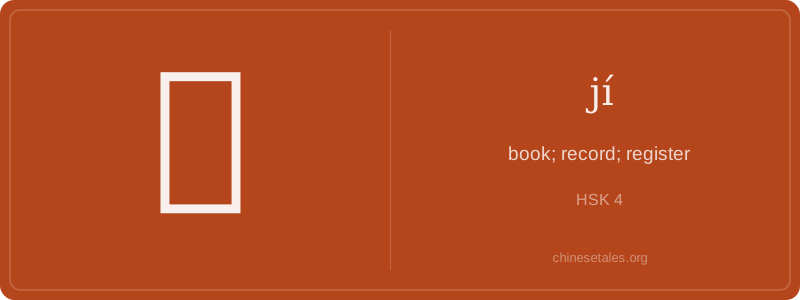
The earliest form of 籍 appears on Warring States bamboo slips — not oracle bones — and shows two clear parts: ⺮ (bamboo) on top, and 藉 (jiè, 'to borrow/use') below, simplified over centuries. The lower part originally depicted 'grass over a person', suggesting 'using grass mats to lay out documents' — a vivid image of scribes organizing bamboo strips on floor mats before binding them. Stroke by stroke, the grass (艹) fused with the 'person' (人) into the modern 舊-like lower component, while the bamboo radical stayed proudly on top — a permanent reminder of where Chinese bureaucracy was literally written.
This visual logic held for millennia: bamboo = medium, arrangement = purpose. In the Book of Rites, 籍 referred specifically to 'land registers' used for tax assessment — not literature, but state control. By the Han dynasty, it expanded to 'ancestral records', linking identity to lineage and place. Even today, 籍guàn (jíguàn) — your registered ancestral origin — echoes that ancient idea: who you are is officially defined by where your family’s name first appeared in the state’s bamboo-bound ledgers.
籍 (jí) feels like a quiet librarian — precise, official, and slightly stern. At its core, it’s about *documented identity*: not just any book, but a formal register — your household registration, ancestral records, or the library’s catalog. Think less 'novel' and more 'bureaucratic ledger'. Its bamboo radical (⺮) hints at ancient writing materials: before paper, scribes carved or inked records onto bamboo slips — and 籍 literally began as 'bamboo-bound documents'.
Grammatically, 籍 rarely stands alone. You’ll almost always see it in compounds like 户籍 (hù jí, 'household registration') or 国籍 (guó jí, 'nationality'). It’s never used as a verb ('to register') — that’s 登记 (dēng jì). A classic learner mistake? Using 籍 as a generic 'book' — no! For 'book', use 书 (shū); 籍 implies authority, permanence, and institutional tracking. Say 我的籍贯是上海 (wǒ de jíguàn shì Shànghǎi), and you’re declaring your ancestral hometown — a legally meaningful detail in China, not just trivia.
Culturally, 籍 carries weight: your 户籍 determines access to public schools, healthcare, and even marriage registration. Migrants without local hukou (户籍) face real barriers — so this character isn’t abstract; it’s woven into daily life and social equity debates. Also, note the tone: jí is second tone — don’t slip into jī (first tone), which means 'chicken' — a hilarious but unhelpful mix-up!