喝
Character Story & Explanation
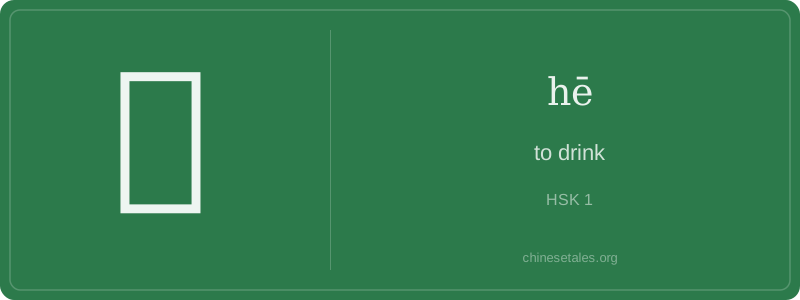
The earliest form of 喝 appears in bronze inscriptions as a combination of 口 (mouth) and 曷 (a phonetic component meaning 'what?' or 'why?'). Though not pictographic like 'sun' or 'tree', its structure is brilliantly functional: 口 anchors the action to speech or ingestion, while 曷 provides both sound and a subtle hint of urgency — imagine someone calling out 'What?!' while reaching for water. Over centuries, the top part simplified from 曷’s complex form (itself derived from a kneeling figure + mouth) into today’s simplified 曷-like shape above 口 — 12 clean strokes balancing phonetic clarity and semantic focus.
By the Warring States period, 喝 was already used for drinking in texts like the Zuo Zhuan, where banquets featured 'drinking rites' (饮酒之礼) governed by strict etiquette. Interestingly, the same character later absorbed the shouting meaning (hè) — likely because both actions involve forceful exhalation through the mouth. This duality is rare: one glyph, two core meanings tied to opposite breath directions — inhaling liquid vs. expelling sound. The mouth radical holds them together like a shared stage.
Think of 喝 (hē) as Chinese’s version of the English verb 'drink' — straightforward, essential, and deeply physical. But unlike English, where 'drink' can be used abstractly ('drink in the view'), 喝 is stubbornly literal: it *only* applies to liquids entering the mouth — water, tea, juice, even soup (though 汤 is often preferred for broth). You’d never say 喝 music or 喝 silence. It’s all about that mouth-to-throat action — which makes perfect sense given its 口 (mouth) radical.
Grammatically, 喝 is beautifully simple at HSK 1: subject + 喝 + object (e.g., 我喝咖啡). No tricky particles needed — unlike verbs like 吃 (eat), it doesn’t require 了 for past tense unless you’re emphasizing completion. A common mistake? Using 喝 for alcoholic beverages without context — while technically correct, native speakers often switch to 喝酒 (hē jiǔ) for 'to drink alcohol', because 喝 alone feels too bare for something culturally weighty like alcohol.
Culturally, 喝 carries warmth and invitation: 喝杯茶!('Have a cup of tea!') is a cornerstone of Chinese hospitality — not just an offer, but a gesture of trust and pause. Learners sometimes overuse it with non-liquid nouns (like 'drink medicine' → better: 吃药 for pills, 喝药 only for liquid medicine), or mispronounce it as hè (which means 'to shout' — think of a general barking orders, not sipping tea).