糖
Character Story & Explanation
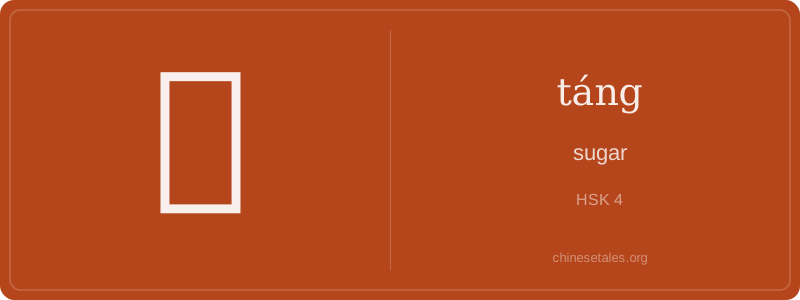
The earliest form of 糖 appears not in oracle bones but in later seal script (c. 3rd century BCE), where it was written as — a compound of 米 (mǐ, ‘rice/grain’) on the left and 唐 (táng, a phonetic component and ancient place name) on the right. The 米 radical wasn’t arbitrary: early Chinese sugar came from sorghum and rice syrups before sugarcane arrived from India via Buddhist monks in the Tang Dynasty (618–907 CE). Visually, the modern 16-stroke 糖 preserves this logic: the top-left 米 (6 strokes) anchors it in agriculture and nourishment, while the right side 唐 (10 strokes) provides pronunciation and subtly evokes the Tang era — when refined sugar production first flourished in China under imperial patronage.
Before the Tang, the character 饴 (yí, ‘malt sugar’) dominated; 糖 emerged specifically to name the new, whiter, crystalline cane sugar imported from India. By the Song Dynasty, 糖 appeared in medical texts like the Compendium of Materia Medica (Bencao Gangmu) as both medicine and indulgence — used to harmonize herbal formulas and soothe sore throats. Its visual duality reflects this dual nature: 米 roots it in sustenance and earth; 唐 lends it elegance and foreign refinement. Even today, when you write 糖, your hand traces the history of cross-continental trade, monastic science, and imperial taste — one grain, one syllable, one revolution in sweetness.
Think of 糖 (táng) as Chinese cuisine’s version of the English word 'sweet'—but with far more linguistic sugar-coating. It doesn’t just mean ‘sugar’ in the granular, white-crystal sense; it’s the umbrella term for all things sugary: cane sugar, rock candy, honey, even artificial sweeteners in colloquial speech. Unlike English, where ‘sugar’ stays firmly noun-like, 糖 slips effortlessly into adjectival or metaphorical roles—like in 甜蜜 (tián mì, ‘sweet and intimate’) or 糖衣 (táng yī, literally ‘sugar coat’, meaning ‘a pleasing veneer over something bitter’). You’ll hear it in health warnings (糖分太高! ‘Too much sugar!’), food labels (无糖, wú táng, ‘sugar-free’), and even slang (糖水, táng shuǐ — not just ‘sugar water’, but a whole genre of Cantonese desserts).
Grammatically, 糖 is delightfully straightforward: it’s a countable noun that rarely needs measure words in everyday use (e.g., 我要糖, wǒ yào táng — ‘I want sugar’), though when quantified, it pairs with 粒 (lì, ‘grain’) for crystals or 块 (kuài, ‘piece’) for hard candy. A classic learner trap? Overgeneralizing it as *the* word for all sweetness—forgetting that 甜 (tián) is the actual adjective meaning ‘sweet-tasting’. Saying 这个糖很甜 is redundant (‘this sugar is sweet’); better to say 这个糖很甜 *or* simply 这个很甜—but never 这个糖很糖!
Culturally, 糖 carries warmth and care: grandparents slip candy into kids’ pockets, doctors warn about ‘hidden sugar’ (隐形糖, yǐn xíng táng), and in literature, sugar often symbolizes fleeting joy or deceptive comfort—think of Lu Xun’s biting line: ‘The sugar-coated pill of flattery hides the bitter medicine of truth.’ Also note: in Mandarin, ‘sugar’ isn’t just culinary—it’s financial slang (e.g., 糖衣炮弹, táng yī pào dàn — ‘sugar-coated bullets’, i.e., corrupting bribes disguised as gifts).