细
Character Story & Explanation
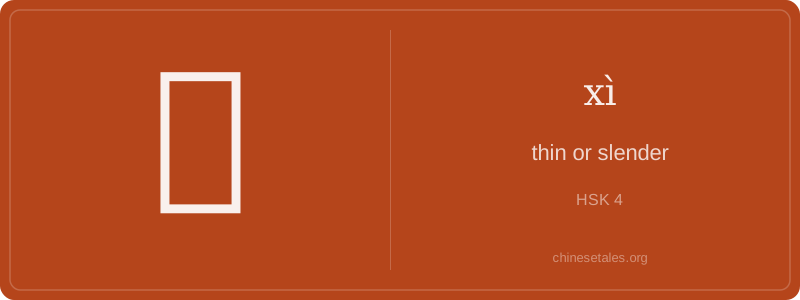
The earliest form of 细 appears in bronze inscriptions as a combination of 糸 (sī, 'silk thread') and 田 (tián, 'field') — but not for agriculture! The 'field' component was actually a stylized representation of twisted threads, emphasizing fineness through repetition and tightness. Over centuries, 糸 simplified into the modern silk radical 纟, while the right side evolved from 田 to the streamlined 勿 — not the 'do not' character, but a phonetic element hinting at pronunciation. By the Han dynasty, the eight-stroke structure we know today had crystallized: two delicate vertical strokes on the left (the silk threads), followed by six precise, controlled strokes on the right — mirroring the very quality it describes.
This visual logic carried into meaning: from literal 'fine thread' in ancient textile records (e.g.,《周礼》mentions 细丝 for imperial garments), 细 broadened to describe anything requiring close attention — thoughts, sounds, feelings. In Du Fu’s Tang poetry, 细草 (xì cǎo, 'slender grass') sways under moonlight, embodying fragility and grace. Even today, the character’s narrow, upright shape feels like a slender reed — a silent echo of its 3,000-year-old origin as a tribute to craftsmanship and care.
Think of 细 (xì) not just as 'thin' but as the Chinese language’s delicate scalpel — it cuts through vagueness to reveal precision, texture, or nuance. Unlike English adjectives that describe size alone, 细 carries a quiet, almost tactile sensitivity: a fine thread, a subtle emotion, a meticulous plan. It’s not about being weak or small; it’s about being finely calibrated — whether describing silk, attention, or criticism.
Grammatically, 细 most often appears as an adjective before nouns (细线 xì xiàn 'fine thread') or in compound verbs like 细看 (xì kàn 'to examine closely'). Crucially, it rarely stands alone as a predicate without modification — you wouldn’t say *他很细; instead, you’d say 他观察得很细 (tā guānchá de hěn xì, 'He observes very carefully'). Learners often overgeneralize it like English 'thin', forgetting its strong association with detail, care, and refinement — not just physical slenderness.
Culturally, 细 reflects a deep-rooted Chinese value: the power of subtlety. In classical poetry, 细雨 (xì yǔ) — 'drizzle' — evokes quiet persistence, not weakness. And in daily life, saying 你太细了 (nǐ tài xì le) to a friend means 'You’re overly meticulous' — sometimes affectionate, sometimes teasing. A common mistake? Confusing it with 系 (xì, 'to tie') or 易 (yì, 'easy') — homophones that share no meaning or shape, but trip up beginners on tone and context.