羽
Character Story & Explanation
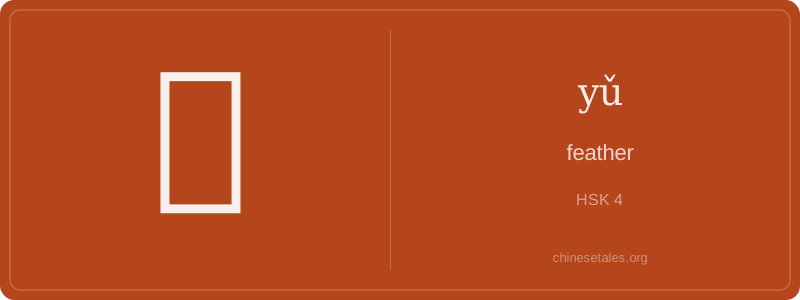
The earliest form of 羽 appears in oracle bone inscriptions as two pairs of parallel, slightly curved lines — like stylized bird feathers lying side by side, sometimes with tiny barbs or tips. Over centuries, these simplified into the modern six-stroke form: two mirrored '习' shapes (each 3 strokes) sharing a central vertical axis — look closely, and you’ll see the left '习' (xi) and right '习' mirroring each other like twin vanes of a quill. The stroke order is deliberate: top-left, top-right, middle-left, middle-right, bottom-left, bottom-right — mimicking the bilateral symmetry of real feathers.
This visual duality shaped its meaning evolution: from concrete 'bird feather' (in Shuōwén Jiězì, it’s defined as ‘bird’s wing coverings’), to abstract notions of lightness and elevation — hence 羽化 (yǔhuà, 'feather-transformation'), describing Daoist sages ascending to heaven. Confucius himself used 羽 metaphorically in the Analects (17.4) when praising music that 'soars like feathers', linking aesthetic refinement to moral cultivation. Even today, the character’s mirrored shape whispers balance — one feather cannot fly alone.
Imagine a quiet courtyard in Suzhou, where an old calligrapher dips his brush into ink and draws 羽 — not once, but twice: first as two delicate, symmetrical feathers floating down from a crane’s wing, then again as the radical in 翼 (yì, 'wing'). That’s how deeply this character breathes life into Chinese — it’s never *just* 'feather'; it’s lightness, grace, flight, and even poetic transcendence. In daily speech, 羽 rarely stands alone as a noun (unlike English 'feather'); instead, it anchors compound words like 羽毛 (yǔmáo, 'feather') or appears in literary or technical terms like 羽化 (yǔhuà, 'to ascend like a feather' — Daoist immortality imagery).
Grammatically, 羽 is almost always bound — you won’t say *'I found a 羽'*; you’ll say *'I found a 羽毛'*. Learners often mistakenly treat it like a free-standing noun (e.g., *'这个羽很美'*) — but that sounds unnatural, like saying 'this feather-ness is beautiful' in English. It also pops up in idioms like 羽扇纶巾 (yǔ shàn guān jīn), evoking Zhuge Liang’s scholarly elegance — where 羽 isn’t about plumage, but cultural poise.
Culturally, 羽 carries ancient weight: in classical music, the five tones included 羽 (the 'la' note in solfège), linking feather-light sound to cosmic harmony. And yes — it’s the same 羽 in 羽毛球 (yǔmáoqiú, 'badminton'), where every shuttlecock literally flies on wings. Mistake it for 易 (yì) or 宇 (yǔ), and you’re not just mispronouncing — you’re swapping feathers for 'change' or 'universe'!