耐
Character Story & Explanation
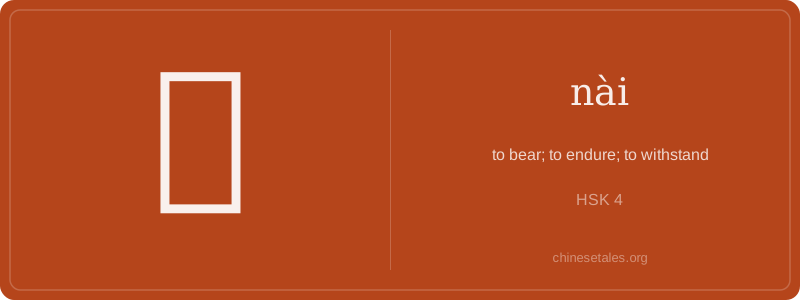
The earliest form of 耐 appears in Han dynasty clerical script—not oracle bones—and already shows its defining structure: the radical 而 (ér, originally a pictograph of a beard, later semantic for ‘face’ or ‘appearance’) atop 大 (dà, ‘big’). Wait—no ‘big’! Actually, the lower part evolved from 又 (yòu, ‘again’/‘hand’), but scribes stylized it into something resembling 大. So 耐 wasn’t ‘big face’—it was ‘beard + hand’, suggesting repeated action (the hand touching or tending the beard), implying persistence. By Tang dynasty, strokes solidified into today’s nine-stroke form: 而 (6 strokes) + 寸 (cùn, ‘inch’, 3 strokes)—a semantic shift where 寸 added the sense of measured, disciplined control.
This visual evolution mirrors its meaning journey: from ‘to handle repeatedly’ (Han glossaries) to ‘to bear steadily’ (Classical texts like the *Huainanzi*, where 耐 is used for enduring exile without resentment). The 而 radical subtly reinforces this—it’s not just physical stamina, but *endurance visible on the face*: unflinching composure. That’s why 耐 is central to idioms like 耐人寻味 (nàirénxúnwèi, ‘enduringly thought-provoking’)—the kind of depth that lingers, quietly, on your features long after reading.
At its heart, 耐 isn’t just about grit—it’s about *graceful endurance*. In Chinese thought, bearing hardship isn’t passive suffering; it’s an active, dignified cultivation—like bamboo bending in wind without breaking. You’ll hear 耐 used for patience (耐烦 nàifán), resilience (耐力 nàilì), or even material toughness (耐磨 nàimó). Unlike English ‘endure’, which often implies grim survival, 耐 carries quiet confidence: the person who 耐得住寂寞 can wait out loneliness without crumbling.
Grammatically, 耐 is almost always verb-initial and takes complements—not objects. You say 耐不住 (can’t bear) + noun/phrase, not *耐+object*. So it’s 耐不住压力 (nài bu zhù yālì), never *耐压力*. It also pairs with 得住/不住 to form potential complements—a classic HSK 4 pattern learners miss. And crucially: you don’t use 耐 alone as a command (✗‘耐!’); it must be embedded—e.g., 你得耐着性子 (nǐ de nà zhe xìngzi, 'you must restrain your impatience').
Culturally, 耐 reflects the Confucian ideal of self-mastery through restraint. Overusing it sounds stoic to the point of coldness—so native speakers often soften it with particles like 着 or 儿化 (耐着点劲). A common mistake? Confusing it with 忍 (rěn, ‘to suppress’)—but while 忍 focuses on internal control, 耐 emphasizes *sustained capacity* over time. Think: 忍 is holding back tears; 耐 is staying calm through three all-nighters.