聚
Character Story & Explanation
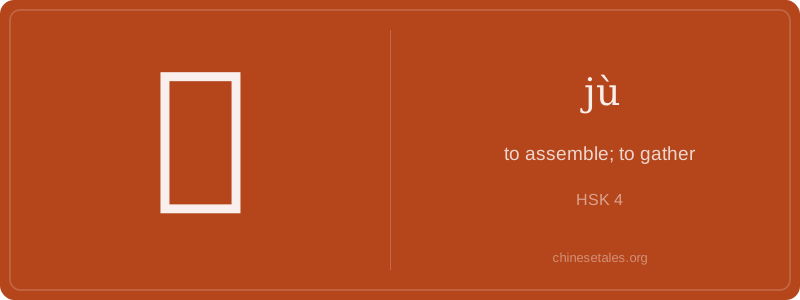
The earliest form of 聚 appears in bronze inscriptions as a compound pictograph: top half showed three mouths (口口口) — symbolizing many people — stacked above a ‘vessel’ or ‘basin’ ( originally resembling 取 or 乕), suggesting people gathering *around* something shared, like food or ritual. Over centuries, the three mouths simplified into the top component 乑 (a variant of 众, ‘many’), while the lower part evolved into 取 (qǔ, ‘to take’), reinforcing the idea of *drawing in*. By the seal script era, the ear radical 耳 was added — not for hearing, but as a phonetic anchor (ancient pronunciation was closer to *gju*), and later standardized as the left-side radical we see today.
This visual logic persisted: 聚 wasn’t about random proximity, but purposeful convergence — like villagers gathering around a well or scholars converging on a master’s teachings. Confucius’s Analects (12.7) uses 聚 to describe how virtue attracts people: ‘德不孤,必有鄰’ — though 聚 isn’t quoted directly, the concept underpins texts like the Book of Rites, where 聚 describes ceremonial assemblies that ‘draw heaven and earth into alignment’. Even today, the ear radical hints at resonance — what gathers doesn’t just occupy space; it *listens*, responds, and harmonizes.
Think of 聚 (jù) as Chinese ‘convergence’ — not just people gathering, but energy, resources, or attention coalescing like iron filings drawn to a magnet. Unlike English 'gather', which often implies gentle collection (e.g., gather flowers), 聚 carries weight, intention, and sometimes urgency: crowds 聚在广场上, data 聚成图表, even emotions 聚在喉头. It’s the verb you use when things *pull together* — physically or abstractly — often with visible density or critical mass.
Grammatically, 聚 is versatile but picky: it’s almost always transitive (takes an object) or used incoverbal structures like 聚集 (jùjí) or 聚拢 (jùlǒng). You’ll rarely say *‘I gather’* alone — instead, *‘We gathered at the café’* becomes 我们聚在咖啡馆 (Wǒmen jù zài kāfēiguǎn). Crucially, it’s not used for harvesting crops (that’s 收 shōu) or collecting stamps (that’s 收集 shōují) — learners often overextend it to passive or hobbyist collecting, which sounds unnatural.
Culturally, 聚 echoes China’s deep-rooted emphasis on collective presence — think family reunions during Spring Festival (团圆聚会 tuányuán jùhuì), or the political weight of ‘mass gatherings’ (群众聚集 qúnzhòng jùjí). A subtle trap: while 聚 can be neutral or positive, context flips its tone — 聚众闹事 (jùzhòng nàoshì) means ‘inciting a mob’, instantly ominous. Also, don’t confuse it with 举 (jǔ, ‘to lift/raise’) — same tone, similar sound, totally different universe.