葡
Character Story & Explanation
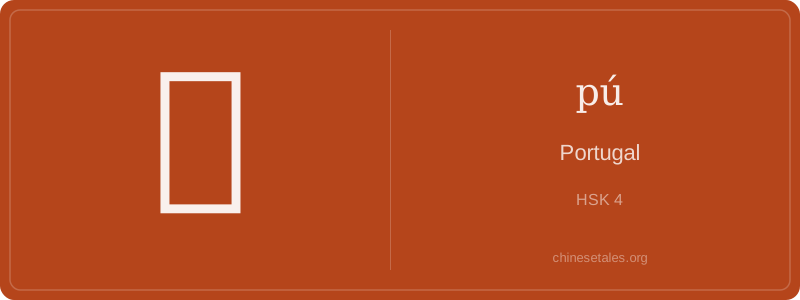
The earliest form of 葡 appears in seal script (c. 3rd century BCE), where it combines the grass radical 艹 at the top — signaling plant life — with 蒲 (pú) below, a phonetic component that itself meant ‘reed’ or ‘rush’. Visually, it was a stylized plant sprouting from water (the ‘water’ element later simplified into the ‘servant’-like strokes beneath 艹). Over centuries, the lower part evolved: the original reed symbol (蒲) lost its ‘water’ component and condensed into the modern 艹 + 匍-like shape — 12 clean strokes today, with the top 艹 clearly marking it as botanical.
Its semantic journey is deliciously ironic: 葡 began as part of 葡萄 (pú tao), the word for ‘grape’, borrowed from the ancient Indo-Iranian word *budhawa via Silk Road traders. When Portuguese sailors arrived in Macau in 1557, locals already knew them as ‘grape people’ — not because they grew grapes, but because they traded wine and were linked to that exotic fruit. By the Qing dynasty, texts like the 1739 Illustrated Treatise on the Maritime Kingdoms formally recorded 葡萄牙 as the official name, cementing the fruit-to-nation metonymy. So visually, 葡 still wears its botanical badge — a vine growing upward, even while naming a European country.
At first glance, 葡 (pú) seems like a simple loanword character — it’s the go-to shorthand for ‘Portugal’ in modern Chinese, used everywhere from news headlines to wine labels. But here’s the cultural twist: unlike English, which borrowed ‘Portugal’ from Latin roots, Chinese didn’t adopt the name phonetically in isolation. Instead, it repurposed an ancient character originally meaning ‘grape’ — because early Portuguese traders brought grapes (and grape wine) to China via Macau in the 16th century, and the association stuck so powerfully that the fruit’s name became the country’s nickname. That’s how Chinese thinking works: concrete, sensory, and deeply rooted in first-contact experience.
Grammatically, 葡 almost never stands alone — it’s always part of a compound: 葡萄 (pú tao, ‘grape’) or 葡萄牙 (pú táo yá, ‘Portugal’). You’ll never say *‘我去了葡’ — it’s always 葡萄牙. It’s also common in compound nouns like 葡萄牙语 (pú táo yá yǔ, ‘Portuguese language’) or 葡萄牙人 (pú táo yá rén, ‘Portuguese person’). Notice the three-syllable pattern: 葡萄牙 is not *‘Púguó’ — learners often misread it as two syllables, but it’s strictly three, matching the Portuguese pronunciation ‘Portugal’.
Culturally, this character reveals how Chinese absorbs foreign concepts through tangible, edible, or trade-related anchors — not abstract names. A common mistake? Writing 葡萄牙 as *‘葡陶牙’ (mixing up 萄 and 陶), or misplacing the radical (thinking it belongs under ‘mouth’ or ‘person’). Also, don’t confuse it with words for other countries ending in -牙 (like 马来西亚 for Malaysia) — those are unrelated; only 葡萄牙 uses 葡 because of the grape connection.