卫
Character Story & Explanation
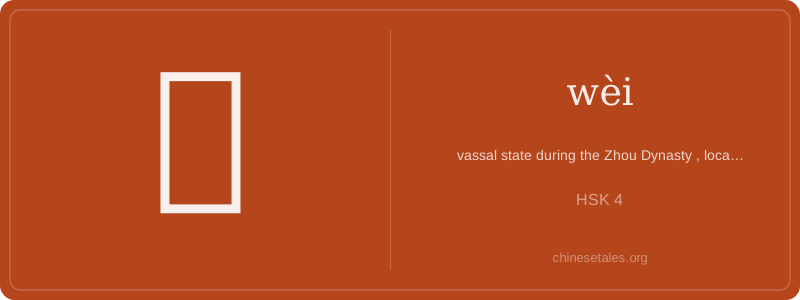
The earliest form of 卫 appears in Western Zhou bronze inscriptions as a stylized pictograph: a curved enclosure (乛) surrounding a simplified representation of a warrior holding a halberd (戈), later reduced to two short strokes. Over centuries, the halberd vanished, leaving only the enclosing curve and two interior dashes — evolving into today’s 乛 + 一 + 丨. That original curve wasn’t decorative; it was a fortified wall or moat — the very boundary of the vassal state. The two inner strokes? Not random — they symbolize vigilant eyes scanning the perimeter or crossed weapons ready at the gate.
This visual logic shaped its semantic journey: from ‘the walled domain of Wei’ → ‘to defend that domain’ → ‘to guard anything of value’. By the Warring States period, philosophers used 卫 in texts like the *Zuo Zhuan* to describe loyal ministers who ‘guarded righteousness’ (卫道 wèidào). Even Mencius praised rulers who ‘defended the people’s livelihood’ (卫民 wèimín). The character’s minimal strokes belie its maximal responsibility — three lines holding up an entire ethical framework of protection.
Picture this: You’re standing at the gates of ancient Wei — not the modern city, but the Zhou Dynasty vassal state nestled between the Yellow River and the Taihang Mountains. A bronze bell rings; soldiers in lamellar armor raise banners bearing 卫. This character isn’t just ‘Wei’ as a proper noun — it’s the *idea* of guarded sovereignty: a territory protected, a duty upheld, a lineage preserved. In modern Chinese, 卫 almost never stands alone meaning ‘vassal state’ — that’s strictly historical. Instead, it lives on as a prefix or component meaning ‘to guard’, ‘to defend’, or ‘hygiene’ (think: guarding health), always carrying that core sense of protective action.
Grammatically, 卫 appears most often in compound nouns (like 卫星 wèixīng ‘satellite’ — literally ‘guarding star’, because early astronomers saw satellites as celestial sentinels orbiting Earth) or verbs like 卫护 (wèihù, ‘to safeguard’). Learners sometimes mistakenly treat 卫 as a standalone verb meaning ‘to guard’ — but it’s nearly always bound: you don’t say ‘我卫他’; you say ‘我保卫他’ (wǒ bǎowèi tā). The bare character 卫 is reserved for proper names (e.g., 卫国 Wèi Guó, the ancient state) or formal compounds.
Culturally, 卫 evokes layered history: the aristocratic ethos of Zhou feudal loyalty, the military pragmatism of border defense, and later, the Confucian ideal of moral self-guardianship. A common slip? Pronouncing it wéi (second tone) — it’s always wèi (fourth tone). And don’t confuse it with 岳 (yuè, ‘mountain’) or 易 (yì, ‘easy’) — visually simple, but historically weighty. Its three strokes hold millennia of vigilance.