规
Character Story & Explanation
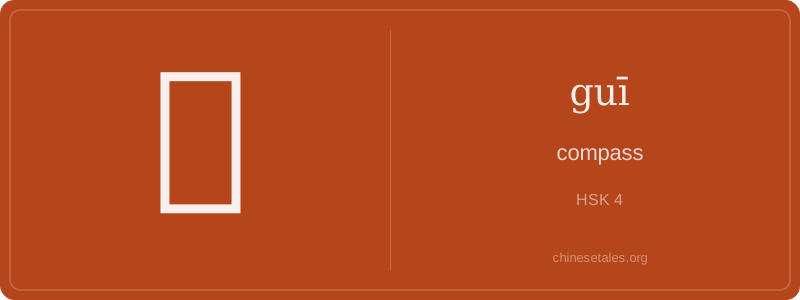
The earliest form of 规 appears on Warring States bamboo slips as a pictograph combining a hand-held tool (represented by the left-side component, later standardized as 夫 + 廾) and the eye radical 见 — not because you ‘see’ with it, but because it *measures what the eye judges as true*. The left side evolved from two hands holding a rotating arm (like a compass’s hinge), while 见 subtly signals intentionality: the user *sees* the center and *intends* perfect circularity. By the Han dynasty, strokes stabilized into today’s 8-stroke form — clean, symmetrical, and balanced, mirroring the very circle it describes.
This character’s semantic journey is profound: from concrete drafting tool (in Mozi’s engineering texts, where 规 was used to verify wheel roundness) to ethical metaphor. In the Analects (12.1), Confucius says, ‘君子怀德,小人怀土;君子怀刑,小人怀惠’ — and though 规 doesn’t appear there, later commentators like Zhu Xi explicitly linked 规矩 (guījǔ) to moral self-discipline: just as a compass ensures fairness in shape, inner ‘compass’ ensures fairness in action. Its visual balance — three strokes left, five right — even echoes the yin-yang harmony it embodies.
At its heart, 规 (guī) is about precision and boundaries—not just the metal compass that draws perfect circles, but the deeper Chinese cultural reverence for order, symmetry, and measured conduct. Unlike English ‘compass’ (a tool), 规 evokes *principle*: in classical texts, it’s paired with 矩 (jǔ, the carpenter’s square) to symbolize moral rectitude—‘the compass and square of virtue.’ That’s why it appears in words like 规则 (guīzé, ‘rules’) and 规范 (guīfàn, ‘standards’): it’s never neutral; it carries quiet authority.
Grammatically, 规 rarely stands alone in modern speech—it’s almost always in compounds. Learners often mistakenly try to use it as a verb like ‘to compass’ (e.g., *‘I guī this circle’*), but no: it’s strictly nominal or adjectival. You say 用圆规画圆 (yòng yuánguī huà yuán, ‘use a compass to draw a circle’), not *‘guī yuán.’* And crucially, while 规 means ‘compass,’ the full term is 圆规 (yuánguī)—never just 规 alone in daily speech. Omitting 圆 turns it abstract or literary.
Culturally, 规 reflects the Confucian ideal that human behavior should be as exact and harmonious as a geometric circle. A common learner pitfall? Overgeneralizing it to mean ‘regulation’ in all contexts—e.g., confusing 规 (compass/standard) with 法 (fǎ, law) or 制度 (zhìdù, system). Also, many misread 规 as guǐ (third tone) because of its radical 见 (jiàn), but it’s firmly guī (first tone)—a tonal anchor worth drilling early.