观
Character Story & Explanation
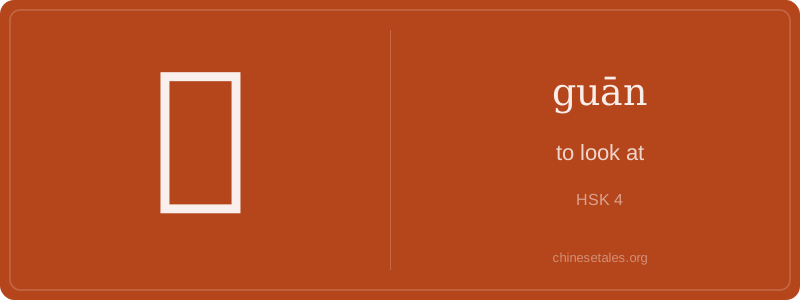
The earliest form of 观 appears on Western Zhou bronze inscriptions as a complex pictograph: a kneeling figure (, later simplified to 又) holding up a large eye (見) — visually representing 'to behold attentively'. Over centuries, the kneeling posture morphed into the left-hand component 丿 + 女? No — wait! Actually, the left side evolved from 雚 (guàn), an ancient pictograph of an owl-like bird with huge, alert eyes (symbolizing sharp observation), which was later simplified to 丿 + 二 + 口 — now rendered as the elegant, flowing 乂-like shape above 见. By the Han dynasty, the character stabilized into its current six-stroke form: a stylized 'eye' radical (见) anchored by a poised, upward-leaning left component.
This visual history explains its semantic depth: 观 wasn’t just 'seeing', but 'seeing with discernment' — a concept central to classical Chinese thought. Confucius urged disciples to 'observe rites' (观礼), and Zhuangzi described sages who 'observe the transformations of Heaven' (观化). Even today, 观 in 观点 (guāndiǎn, 'point of view') retains that sense: not just any opinion, but one formed through careful observation — your mind’s own curated exhibition hall.
Think of 观 (guān) as the Chinese equivalent of a thoughtful, wide-awake gaze — not just 'looking', but observing with intention, like an anthropologist at a street market or a film critic pausing a scene. It’s less about eyeballs and more about engaged perception: you 观察 (guānchá) a trend, 观赏 (guānshǎng) a painting, or 观念 (guānniàn) — literally 'observed ideas' — meaning 'concept' or 'belief'. Unlike English 'look', which is often fleeting ('Look! A bird!'), 观 implies duration and depth.
Grammatically, it rarely stands alone as a verb in modern speech — you won’t say *'I guān the mountain'*; instead, it appears in compound verbs (观看, 观察), nouns (观众, 观点), or formal written contexts. Learners often overuse it as a bare verb (a fossilized habit from textbook drills), when 看 (kàn) is far more natural for everyday 'looking'. Also beware: 观 is never used for 'watching TV' — that’s 看电视, never *观电视.
Culturally, 观 carries philosophical weight: in Daoist texts like the Daodejing, 观 means contemplative witnessing of the Dao — quiet, non-judgmental attention to natural flow. That’s why 观念 feels so abstract: it’s not just 'idea', but an idea formed through observation. Mistake this for 看 and you lose nuance — like swapping 'contemplate' for 'glance' in a philosophy essay.