许
Character Story & Explanation
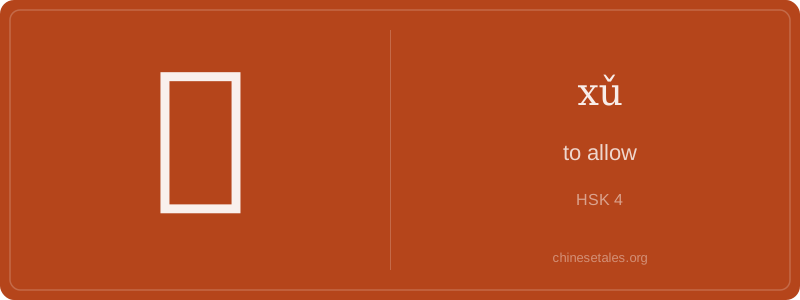
The earliest form of 许 appears in bronze inscriptions (c. 1000 BCE) as a compound: the left side was 言 (yán, 'speech'), and the right was 午 (wǔ, 'noon'), which originally depicted a pestle pounding grain — symbolizing rhythmic, deliberate action. Over centuries, 言 simplified to the modern speech radical 讠, while 午 lost its pictographic detail and became the clean, angular shape we write today. Crucially, this wasn’t just 'speech + noon' — 午 here functioned phonetically (both 午 and 许 share the ancient *-a* rhyme), anchoring pronunciation while 言 anchored meaning: speech that grants permission.
In classical texts like the *Zuo Zhuan*, 许 appears in diplomatic contexts — e.g., '许其请' (xǔ qí qǐng, 'granted his request') — highlighting its role in ritualized agreement between states or lords. The character’s visual duality — speech + a time marker — subtly reinforces that permission isn’t spontaneous; it’s a measured, timely act. Even today, the ‘noon’ component hints at clarity and decisiveness: when you say 许, you’re not hedging — you’re giving a clear, sunlit yes.
At its heart, 许 (xǔ) is about permission — but not the stiff, bureaucratic kind. It’s the warm, human 'yes' you get when a parent nods to a child’s request, or when a friend agrees to meet up. Think of it as linguistic consent: soft, relational, and often spoken with a slight upward lilt. Unlike the formal 批准 (pīzhǔn, 'to approve'), 许 carries emotional weight — it implies trust, willingness, and personal agency.
Grammatically, 许 shines in two key patterns: first, as a verb meaning 'to allow' (e.g., 老师不许我迟到 — 'The teacher doesn’t allow me to be late'); second, in the structure '许 + Verb', where it expresses potential or tolerance ('can/may do X') — like 他许诺帮忙 (tā xǔnuò bāngmáng, 'He promised to help'). Watch out: learners often overuse 许 as a direct translation of English 'allow', forgetting that in Chinese, context often drops the subject or shifts to passive constructions like 被允许 (bèi yǔnxǔ). Also — crucial! — 许 is rarely used alone; it almost always partners with another verb or appears in compounds.
Culturally, 许 reflects Confucian relational ethics: permission isn’t abstract law — it’s granted *between people*, rooted in hierarchy and care. That’s why you’ll see it in classical phrases like '不许妄动' (bù xǔ wàng dòng, 'Don’t move recklessly!') — a gentle yet firm boundary. A common mistake? Confusing 许 with 需 (xū, 'need') — same tone, similar stroke count, but wildly different meanings. Remember: 许 is *speech* (讠) + *noon* (午), not *rain* (雨)!